
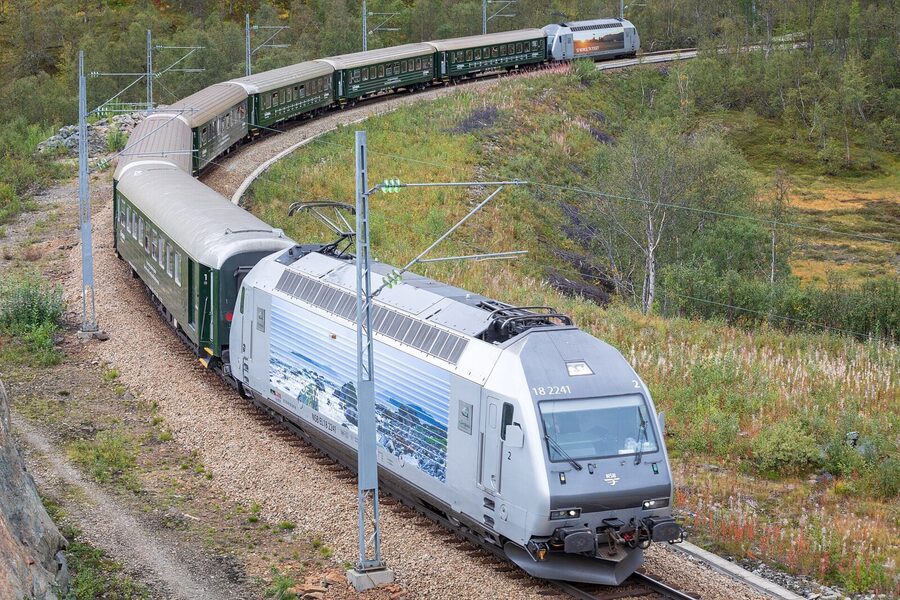

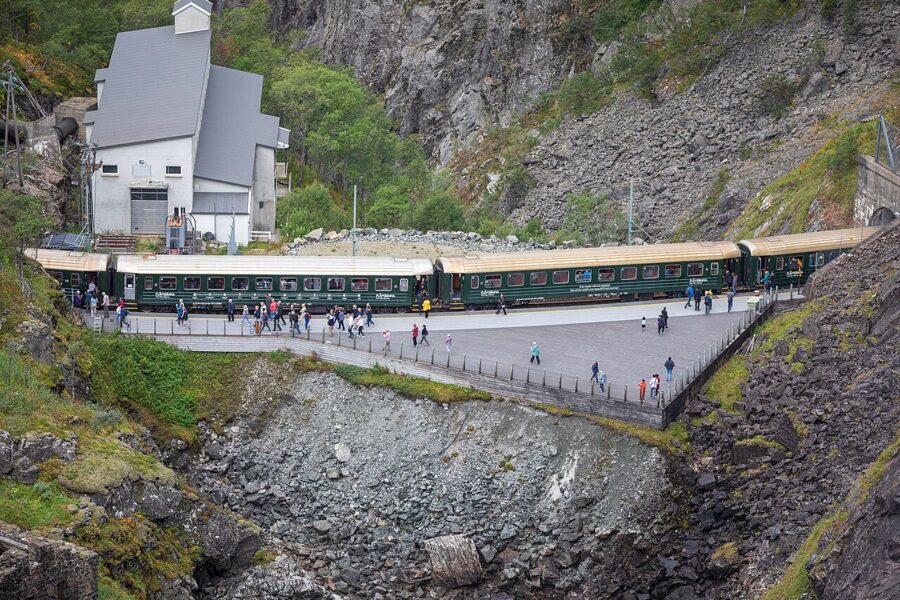
A quarter of an hour below Myrdal the train comes out of a tunnel, brakes hard and stops beside a concrete terrace built out over a river. The doors open, and the noise arrives before the view: Kjosfossen, a few metres away, throwing enough spray across the platform to fog every phone held up to it. Five minutes later the carriages are full again and the train carries on down the mountain at no more than 40 km/h.
That is the Flåm Railway (Flåmsbana): 20 km of track from Myrdal, a station on the Bergen Line at 867 metres with no road to it, down to Flåm at the head of the Aurlandsfjord. The ride takes about an hour each way and runs every day of the year, four times a day in winter and ten in high summer. A single costs from NOK 399 and a return from Flåm from NOK 675.
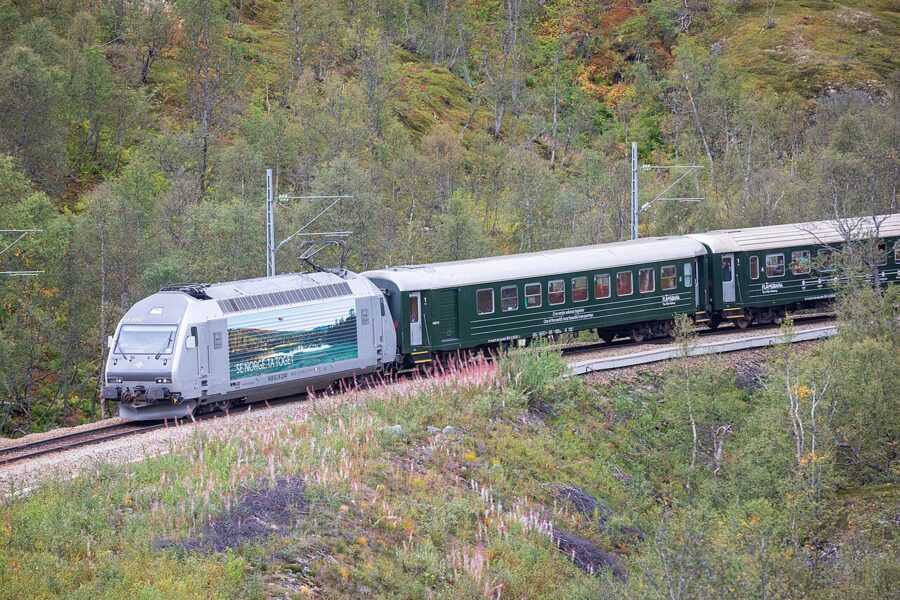

There are three ways to fit it in. Coming from Oslo or Bergen, you buy one through ticket on the Bergen Line, change at Myrdal and ride down. Staying in Flåm, you ride up and straight back as a round trip. Or it is the middle leg of Norway in a Nutshell, where the line, the Nærøyfjord boat and the bus to Voss are sold as one loop.
It is crowded in July and quiet in February, and it is worth doing in both.


Tickets and fares
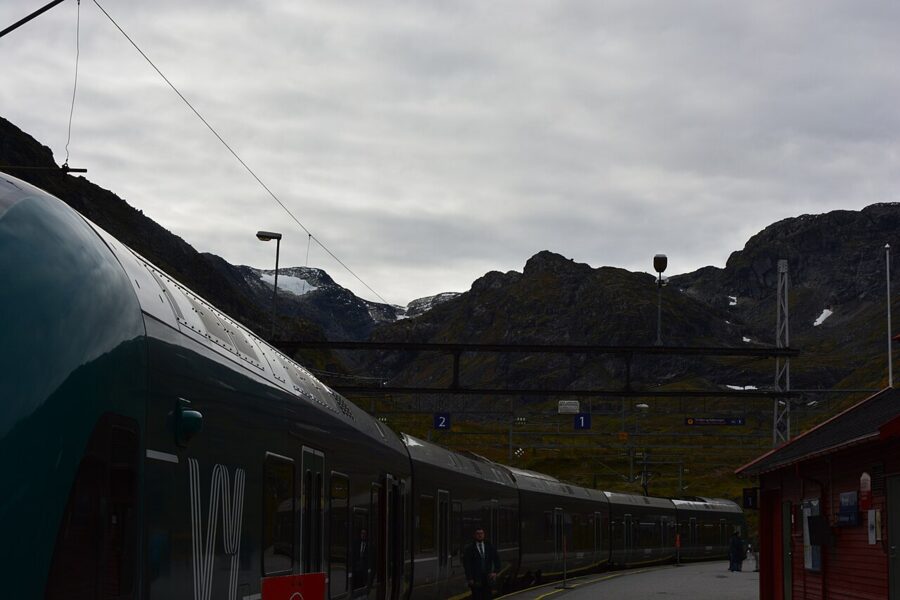
The fare structure is simple once you see who sells what. Vy, the national rail operator, runs the trains and sells every kind of ticket for the line, including through tickets from anywhere on its network. Norway’s Best, the Flåm company that markets the railway with Vy, sells the round trip from Flåm and the packages that combine the train with the zipline, a bike or a walk. Both sell the same seats.
| Ticket | Price | Sold by |
|---|---|---|
| Adult single, Myrdal to Flåm or Flåm to Myrdal | from NOK 399 | Vy |
| Child single, aged 6–17 | half the adult fare | Vy |
| Round trip Flåm–Myrdal–Flåm | from NOK 675 | Norway’s Best |
| Bicycle | NOK 280 | Vy |
| Dog | free | |
| Interrail or Eurail pass, active travel day | 30 per cent off an ordinary single | Entur, staffed stations, Vy by phone |
A few rules catch people out. The return price only exists for Flåm–Myrdal–Flåm; if you start at Myrdal and want to go down and back up, you pay two singles. There are no student or senior discounts, no first class and no reserved seats for individuals: seating is open, and only groups of ten or more booking direct get places held for them. A ticket is valid on the departure printed on it and no other.
Myrdal has no ticket office and no machine, so nobody should arrive there without a ticket for the line down. Buy the whole journey on Vy’s Flåm Railway page or in the Vy app, which sells Oslo–Flåm or Bergen–Flåm as one ticket with the change built in. Pass holders cannot use the discount online through Norway’s Best; the 30 per cent reduction is sold through Entur, at staffed stations and on Vy’s customer phone line.
Booking ahead
Tickets go on sale 120 days before departure. In July and August the mid-morning departures from Flåm sell out, and when they do, they stay sold out: there is no waiting list, and customer service at Flåm holds back no extra seats. Cancellations sometimes free a seat far in advance, rarely in the last week.
Outside June to August I would still book a few days ahead and not worry. In winter you can usually buy on the morning. The one thing worth booking early all year is a bicycle space, because both this line and the Bergen Line carry only a handful of bikes per train.

Through tickets from Oslo and Bergen
The Bergen Line reaches Myrdal from Oslo in about five hours and from Bergen in about two, and the Flåm Railway is timed to meet most day trains in both directions. On a through ticket the connection is part of the booking, and the seat reservation on the Bergen Line is free.
The change at Myrdal is a walk across one platform. In summer the whole of a long Bergen Line train empties onto that platform at once. The people who walk briskly get the window seats; the people who stop to photograph the station sign stand in the aisle.
Timetable through the year
The pattern repeats every year, with the change dates shifting by a few days. The Flåm Railway timetable for the current and next season is published by Norway’s Best, and Vy’s journey planner has the connections at Myrdal.
| Period | Return trips a day | First up from Flåm | Last down from Myrdal |
|---|---|---|---|
| November–March | 4 | about 09:00 | about 18:05 |
| April | 6 | about 08:20 | about 17:10 |
| Late April–mid-September | 10 | 07:20 on weekdays, 08:20 at weekends | about 19:35 |
| Mid-September–early October | 9 | 07:20 on weekdays, 08:20 at weekends | about 18:20 |
| Early October–early November | 6 | 08:20 on weekdays, 09:35 at weekends | about 17:10 |
There are fewer trains on 24, 25 and 31 December. The winter trains are a little quicker, about 45 minutes uphill, partly because in summer the up and down trains wait to cross at Berekvam; in summer allow just under an hour each way.
The last train is the one to plan around. In winter the final departure down from Myrdal leaves around six in the evening, and if a delayed Bergen Line train misses it you are at a station with a waiting room, toilets and no road. The waiting room at Myrdal is open around the clock, which is a comfort, not a plan.

The cruise-ship days
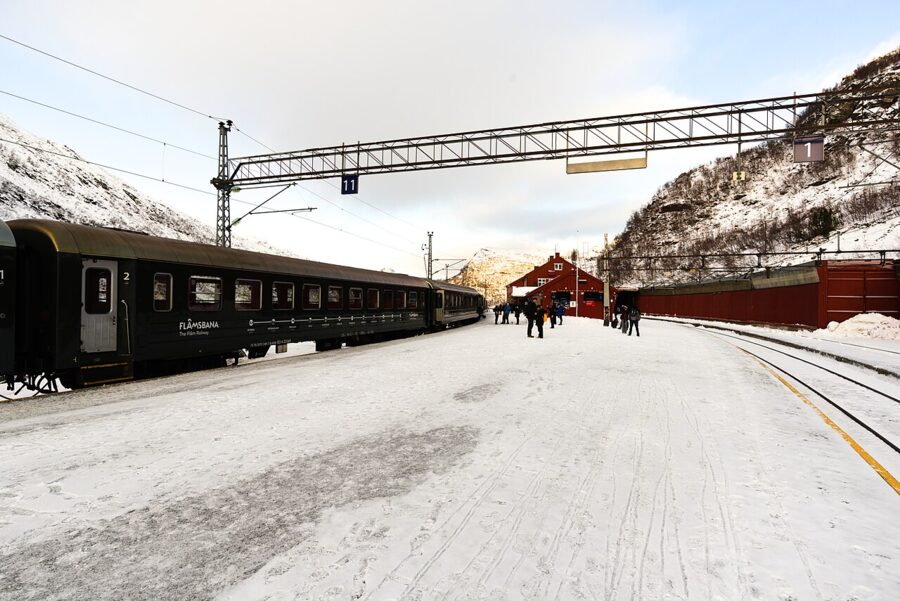
Flåm has one deep-water quay and takes one cruise ship at a time, and from May to September there is a ship on roughly twenty days a month. Many of them carry 4,000 to 6,600 passengers. They usually berth between 06:30 and 08:00 and sail at about 18:00, for Stavanger, Ålesund or the Geirangerfjord.
On those days the mid-morning trains up from Flåm and the early-afternoon trains down from Myrdal fill with ship passengers on round trips. The trains either side of them, the first departure of the morning and the last two of the evening, are usually calmer. The port publishes its ship arrival list for the whole season, and I would check it before choosing a date and a departure.
Winter on the line
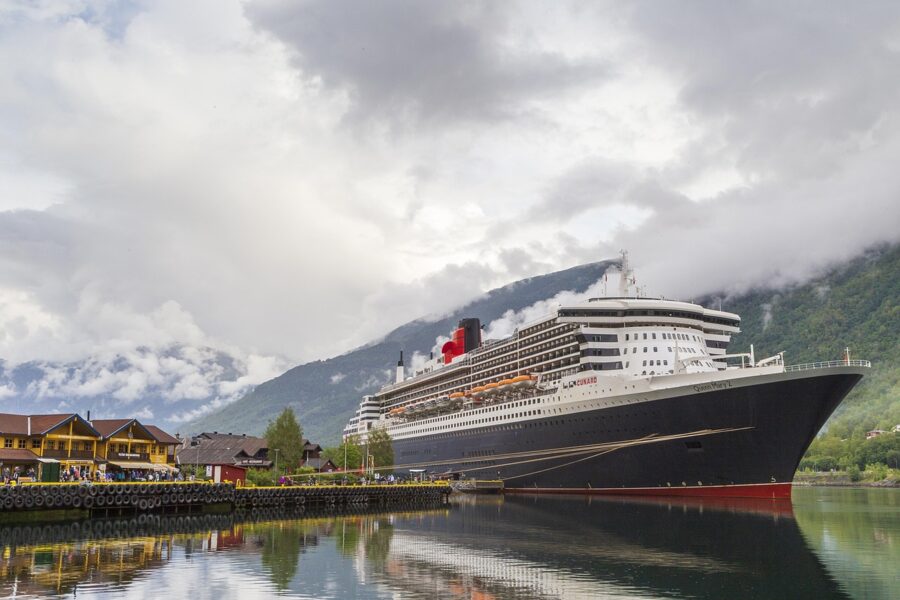
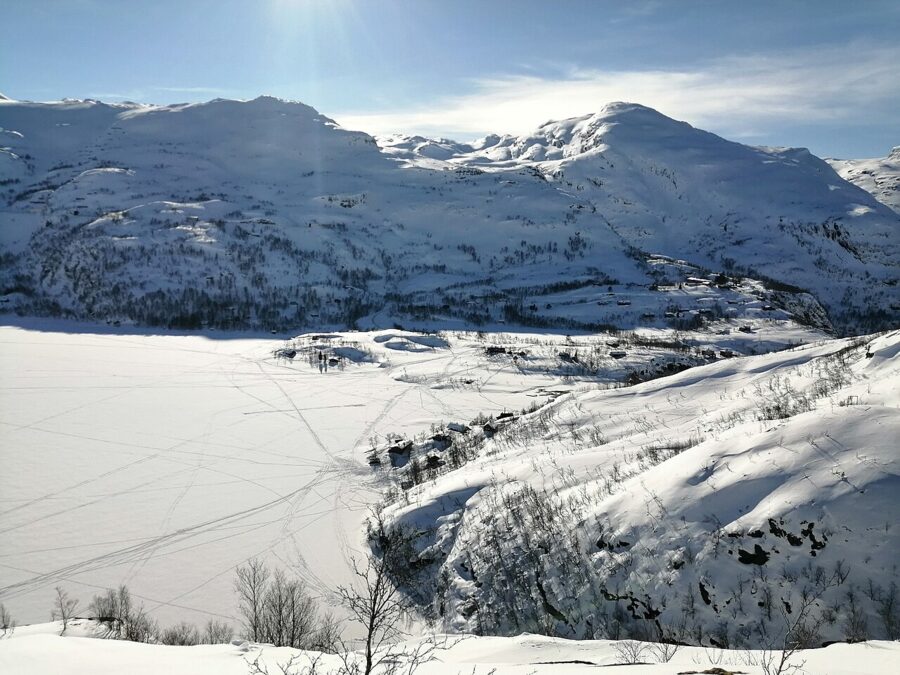
Winter is the season I would pick for the ride alone. Kjosfossen hangs frozen beside the halt, the valley is white from the snow sheds to the fjord, and the carriages are half empty. The cost is four trains a day, short light and the occasional closure when snow or rockfall blocks the line; Bane NOR, which owns the track, has had to shut it for slides several times over the years, usually for a day or two.

Which side to sit on
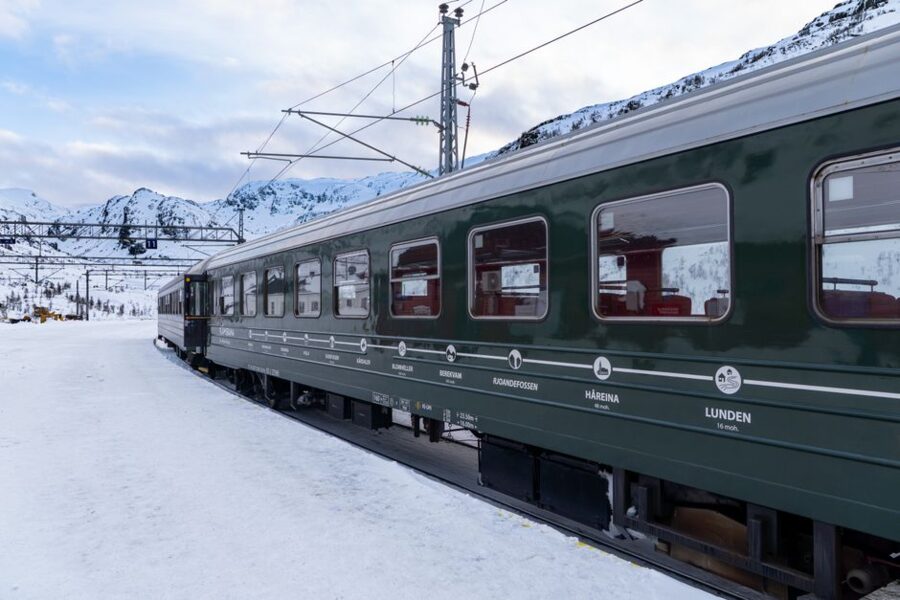
The standard advice is the left side going down from Myrdal and the right side coming up from Flåm, and it is right more often than not. It wins on the bends below Myrdal, the long look down the valley from the snow sheds above Kjosfossen, and near Flåm the church and Brekkefossen. In the middle of the line the views swap sides every few hundred metres, and on the way down the mountain farms at Ryo, Holo and Geisme are on the right.
A window seat on the wrong side still beats an aisle seat on the right one. And Kjosfossen you see on foot from the platform whichever side you sat, so do not plan around it.
If you are doing a round trip from Flåm, sit right going up and left coming down, and you will have had both. That is the strongest argument for the round trip over a single.

The ride, stop by stop
The line has nine stations and halts, and the train stops at all that are in use. Some are request stops, marked with an x in the timetable: tell the conductor if you want to get off, and stand on the platform where the driver can see you if you want to get on. Going down, in order, the line runs like this.
Myrdal and Vatnahalsen
Myrdal sits between two Bergen Line tunnels at 867 metres. Café Rallaren in the station building serves soup, porridge and coffee, daily in summer and on shorter hours through the winter, closed over Christmas; check Café Rallaren’s opening hours before relying on it. Outside those hours there are vending machines and toilets, but nowhere to leave luggage.
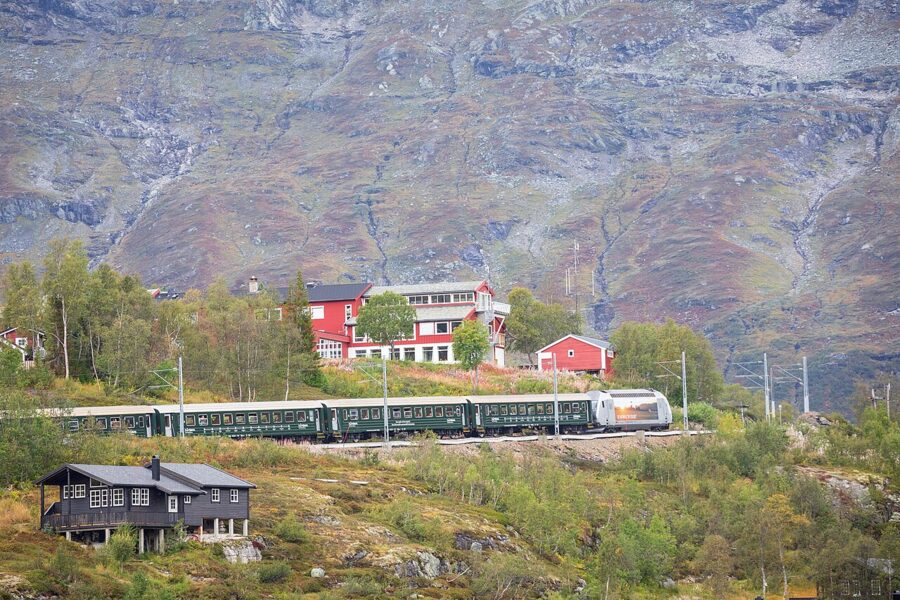
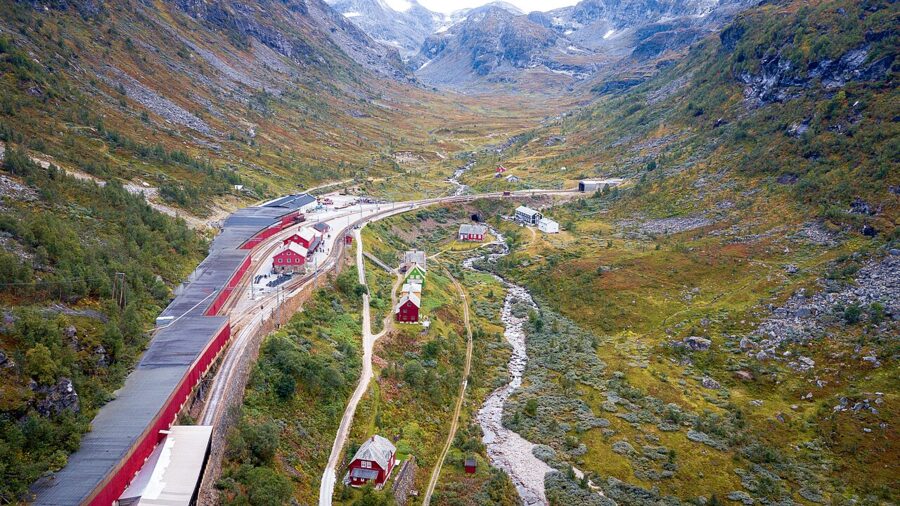
The train leaves through tunnels and snow sheds and stops a few minutes later at Vatnahalsen, at 820 metres. The red buildings beside the halt are Vatnahalsen Høgfjellshotell, a mountain hotel since 1896 that you can only reach by rail, bike or on foot. Vatnahalsen opens for skiers in winter and for Rallarvegen cyclists in summer, and serves waffles in the sun wall to anyone passing.

Reinunga and the horseshoe
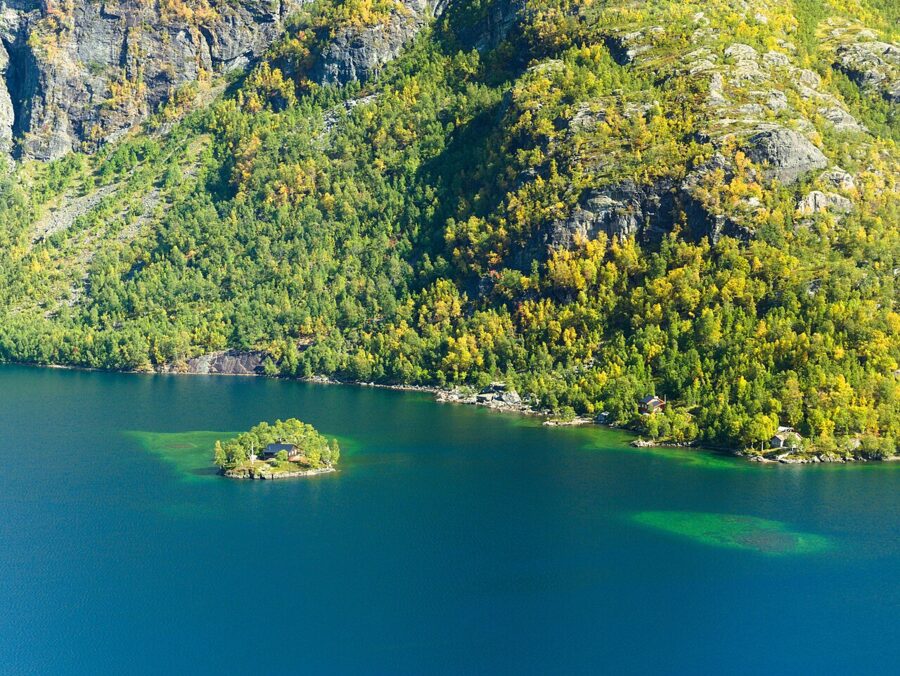
Below Vatnahalsen the track swings through a horseshoe in the open to lose height, past the lake at Reinunga. Reinunga halt and Kjosfossen halt are only 400 metres apart as the crow flies, but over 2 km apart by rail. The difference is the turning tunnel between them, a 180-degree curve inside the mountain that the engineers used to spread the gradient.

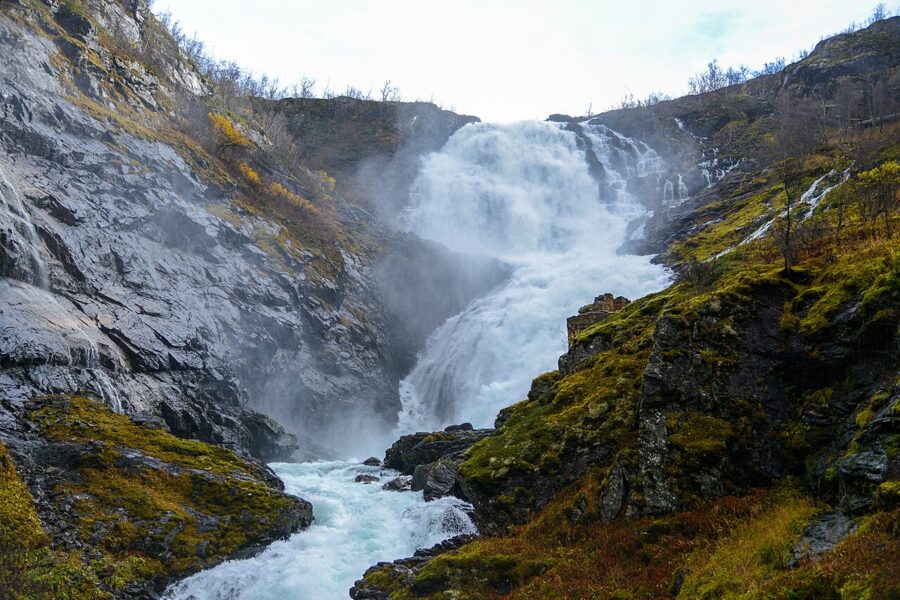
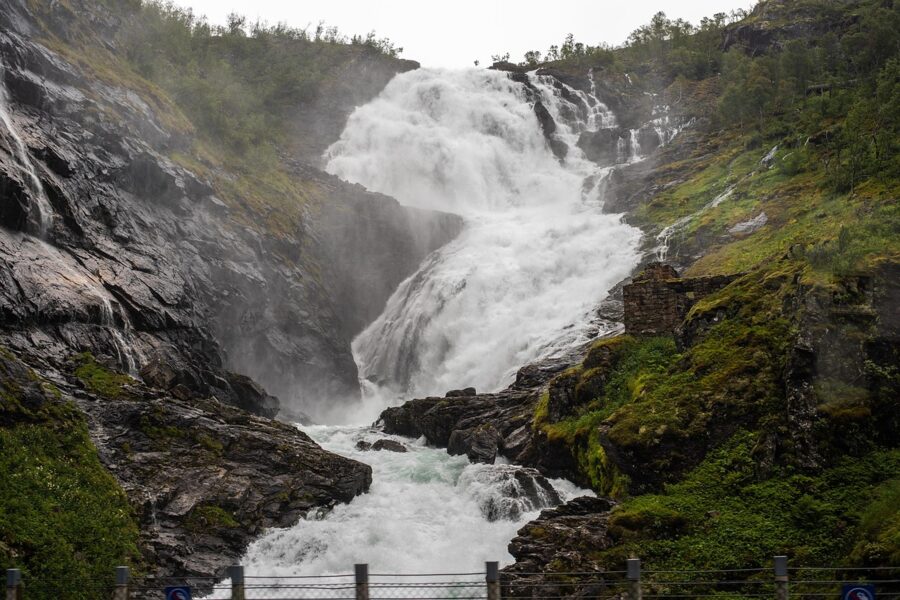
Kjosfossen
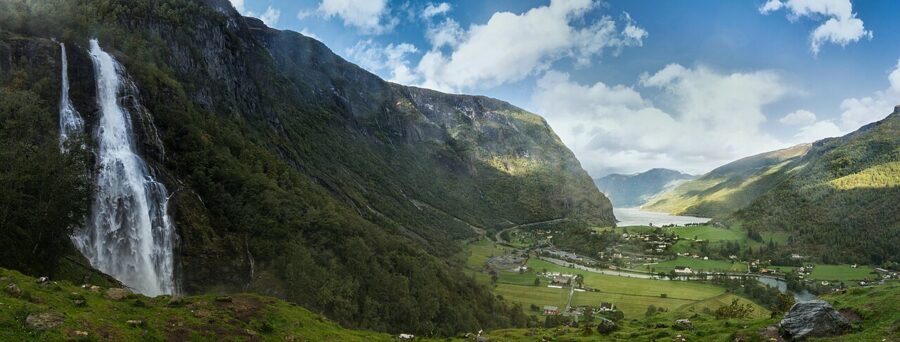
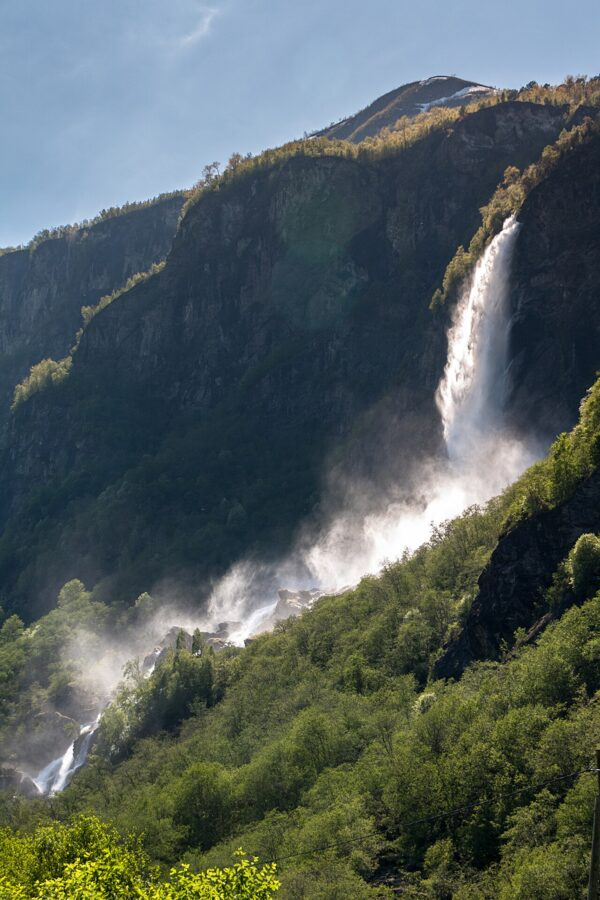
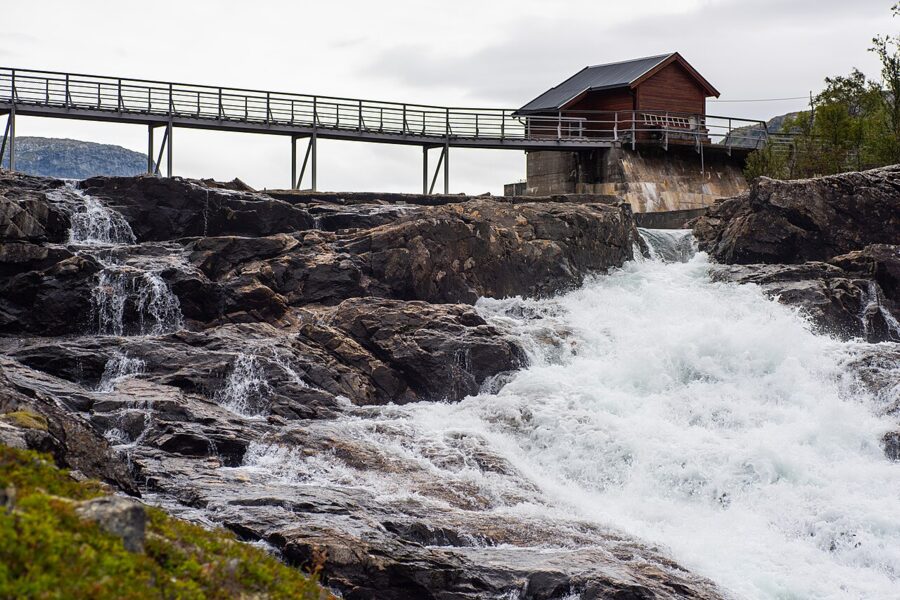
The waterfall drops from Reinungavatnet in a series of cascades and disappears into a tunnel under the railway. Sources give its height as 93 metres for the main fall beside the platform and about 225 metres for the whole drop; both are fair, and neither matters when you are standing in it. The open terrace replaced a narrow platform in 2000, and the stop has existed since 1951 for no reason other than letting people off to look.
On summer departures the music starts while you are on the terrace, and a dancer in red appears among the rocks above as the huldra, the forest spirit of Norwegian folklore. Some people love it and some look at their watches. In winter there is no performance, and the fall is a column of blue ice.

The halt is not accessible for wheelchair users, and the carriage with the wheelchair spaces does not stop with a view of the fall. Norway’s Best sells return tickets with one of the two wheelchair spaces on each train reserved.
Blomheller, Berekvam and the middle valley
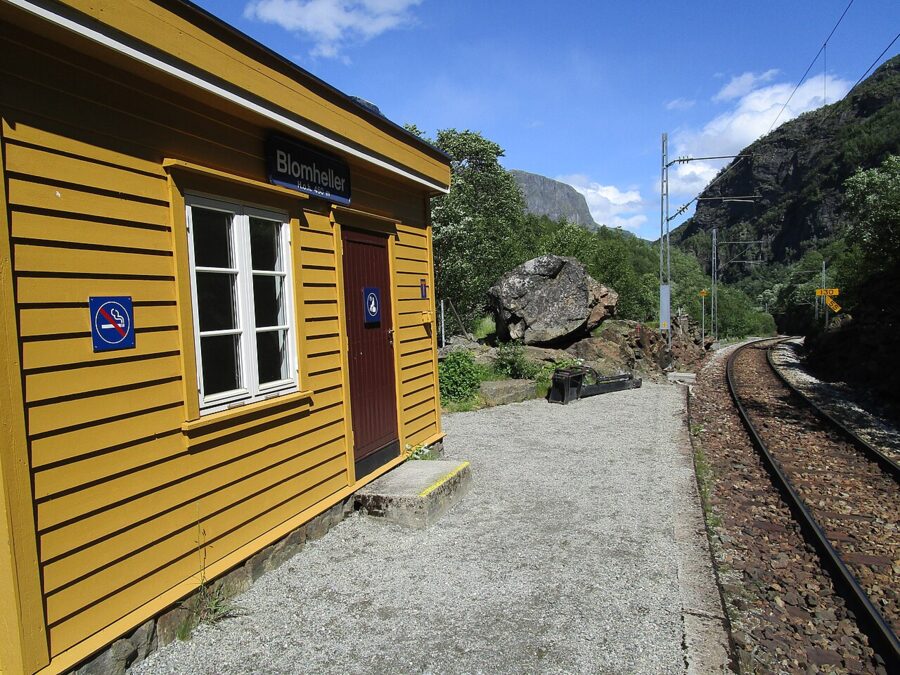
After Kjosfossen the line drops through the Nåli tunnel, the longest on the route, and between the next tunnels there are views down to the Kårdal farm and Kårdalsfossen. Blomheller, at 458 metres on the Melhus farm, is a request stop and the nearest halt to the bottom of the zipline at Kårdal. It could not be called Melhus because a station on the Dovre Line already had the name.
Berekvam, halfway down, is the one place on the single track where two trains can pass. In summer the up and down trains meet here and one waits for the other, which is why the summer timetable is slower than the winter one. Only one of the two tracks has a platform, so only one train lets people on and off during a crossing.
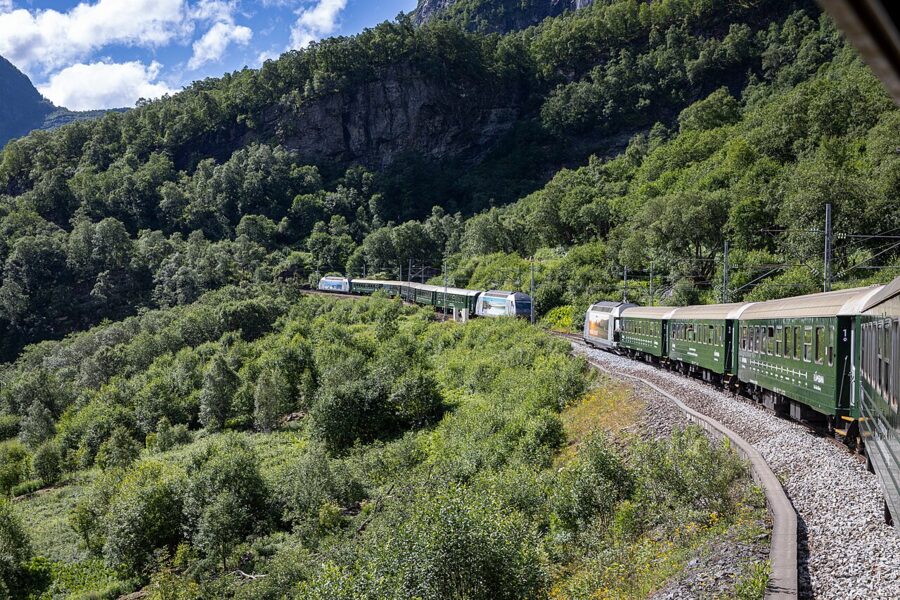

Below Berekvam the line crosses the valley on a great embankment, with the river sent through a tunnel underneath, and Rjoandefossen pours down the far side. Look up on this stretch for the farms on their shelves high above the valley floor, still worked, reached by paths that look impossible from the train.

Håreina, Lunden and Flåm
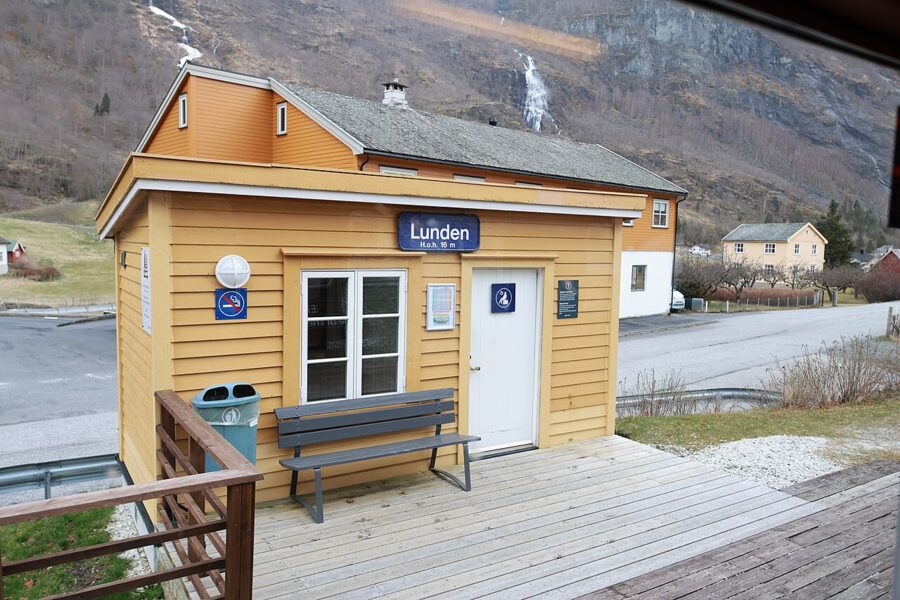
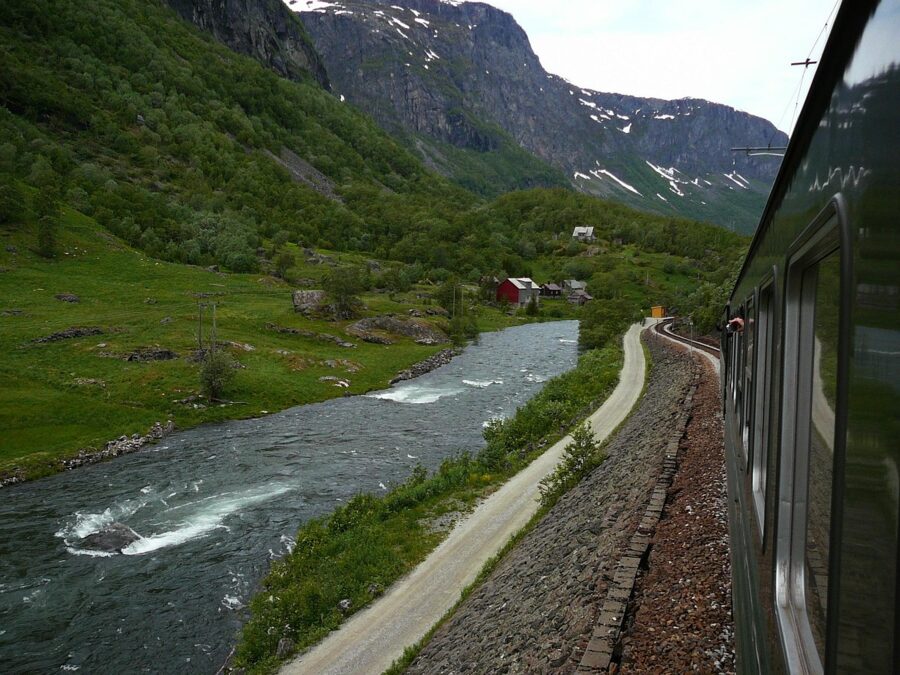
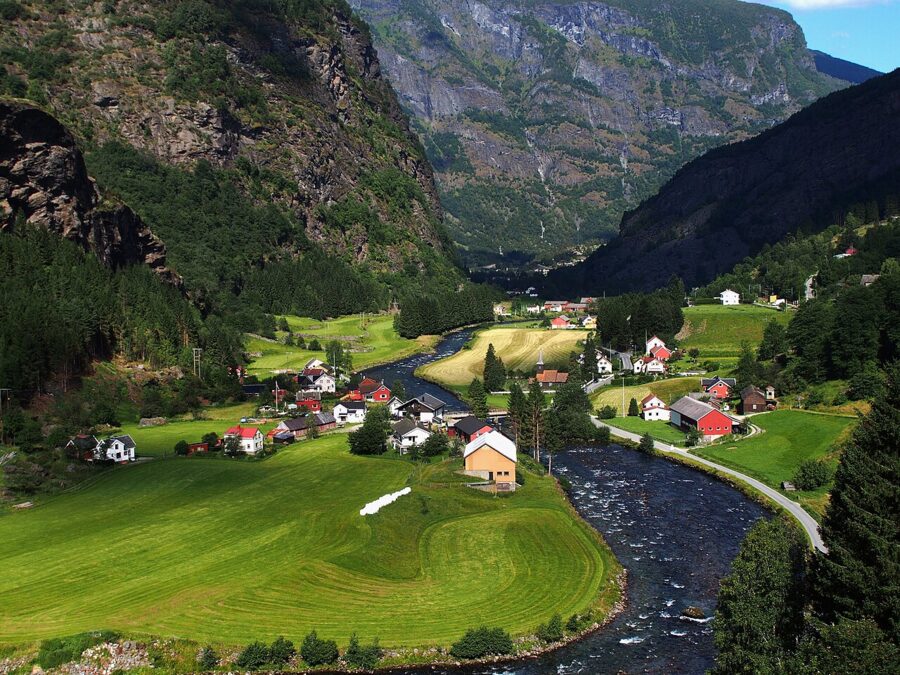
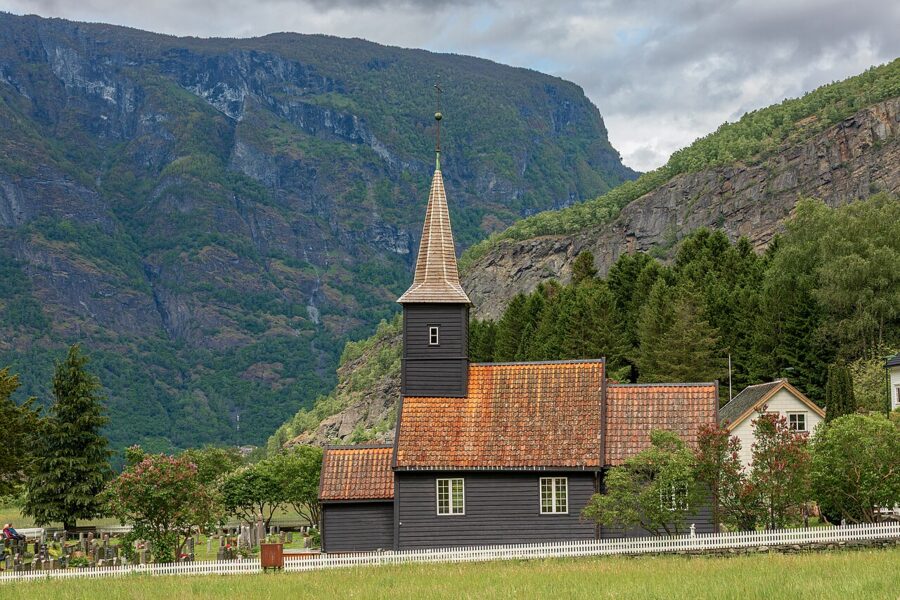
The last stretch runs along the floor of the valley beside the Flåmselvi river. Håreina is the halt for Flåm church, the dark wooden church of 1670 in the old centre of the village, about 3 km up the valley from the modern harbour. Lunden, a short wooden platform and a waiting room, opened in 1942 with the start of regular passenger traffic. Then the train runs out onto the flat at Flåm station, a few metres from the fjord.

How the line was built
The idea of a branch from the Bergen Line down to the Sognefjord is older than the Bergen Line itself: a forester from Voss proposed it in 1871. Parliament chose the Flåm valley route in 1908, first as a rack railway and then, in 1916, as an ordinary adhesion line, with no cogs or cables at all. Work started in 1923–24, under a decision that the line would be electric from the start.
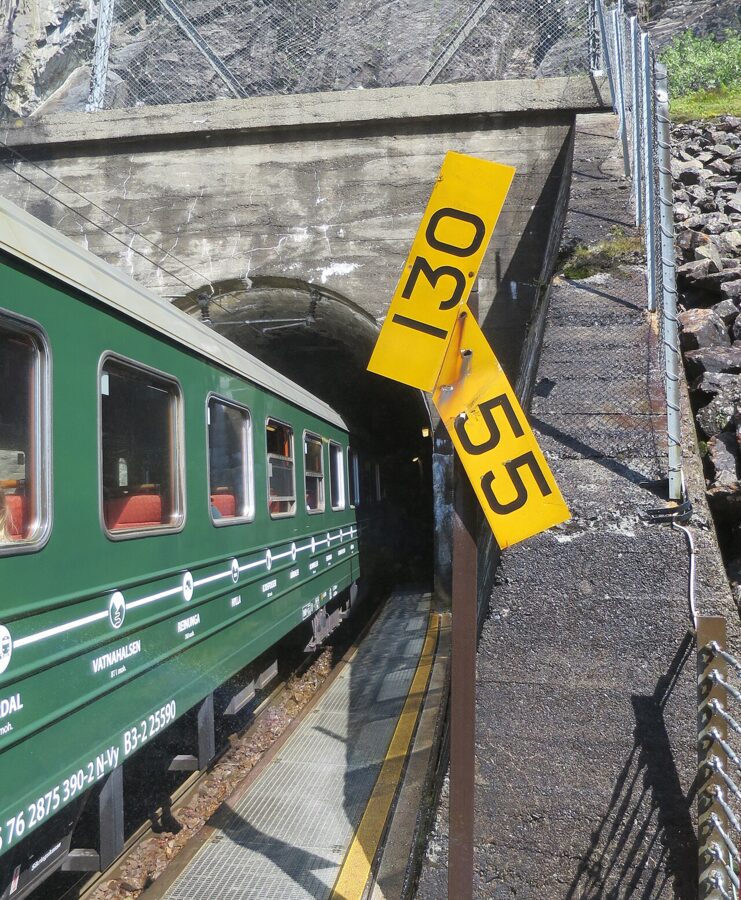
The engineering numbers explain the speed you ride at. Most of the line climbs at 55 per mille, one in eighteen, and the tightest curves have a radius of 130 metres; the trains are limited to 40 km/h. There are 20 tunnels with 5,692 metres between them, and 18 were dug by hand, at a rate the railway’s own history puts at a month of one man’s labour for every metre.

The navvies lived in barracks at Myrdal, Kårdal, Berekvam and Flåm, and in houses along the valley. Drilling dust gave many of them silicosis. To save money the valley was crossed on embankments, three times, with the river put through tunnels instead of under bridges.
Then the war arrived first. When Germany invaded in April 1940, five kilometres of track were still to be laid; the occupying authorities ordered the work finished, and the first trains, hauled by small steam locomotives, ran on 1 August 1940. Passengers were allowed from 10 February 1941, and on 24 November 1944 the line went electric, months late because a resistance group from Oslo had blown up the transformers. It was never formally opened until a ceremony for its 40th anniversary in 1980.
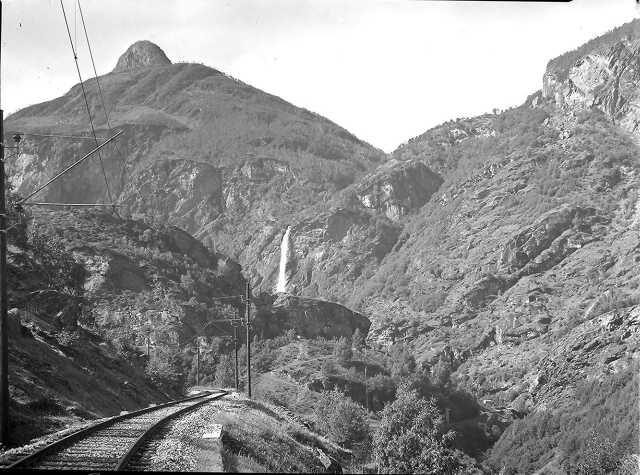
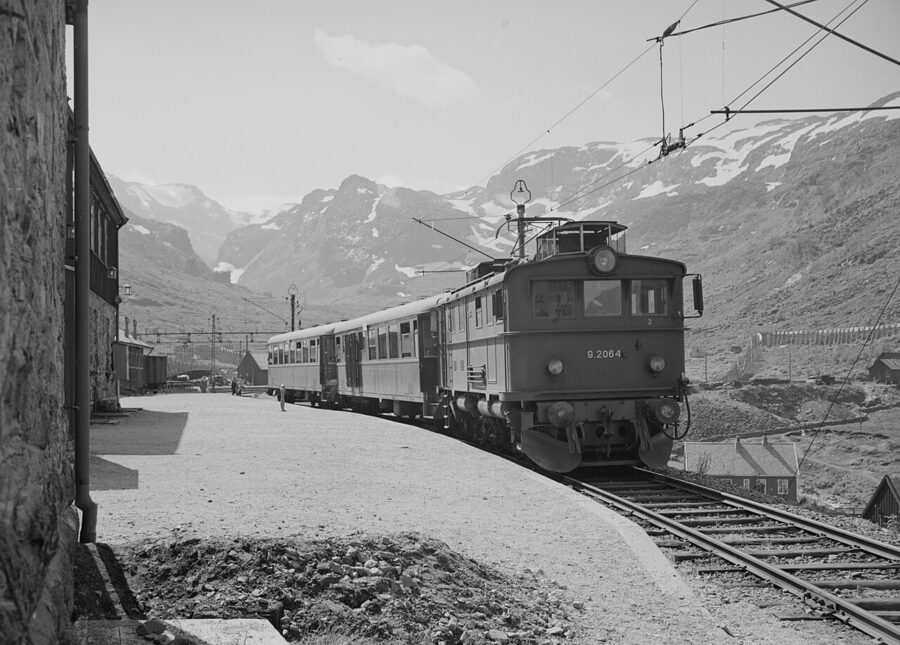
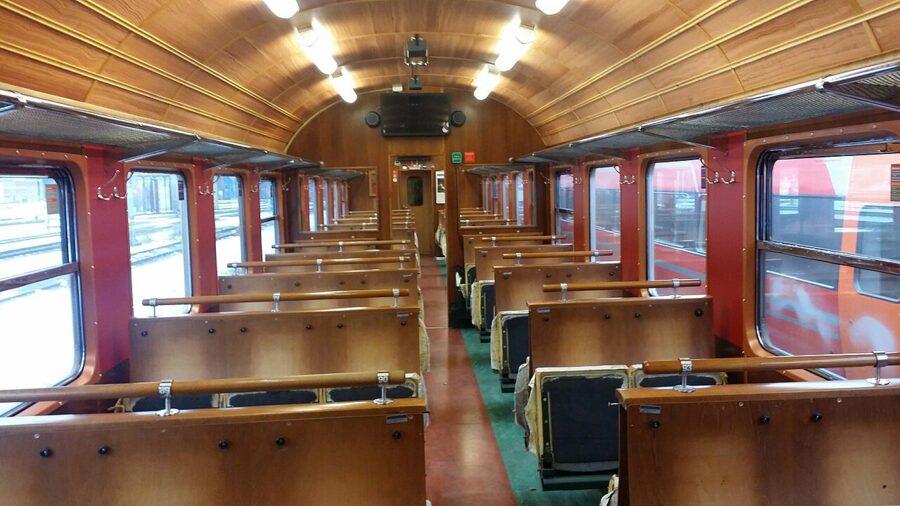
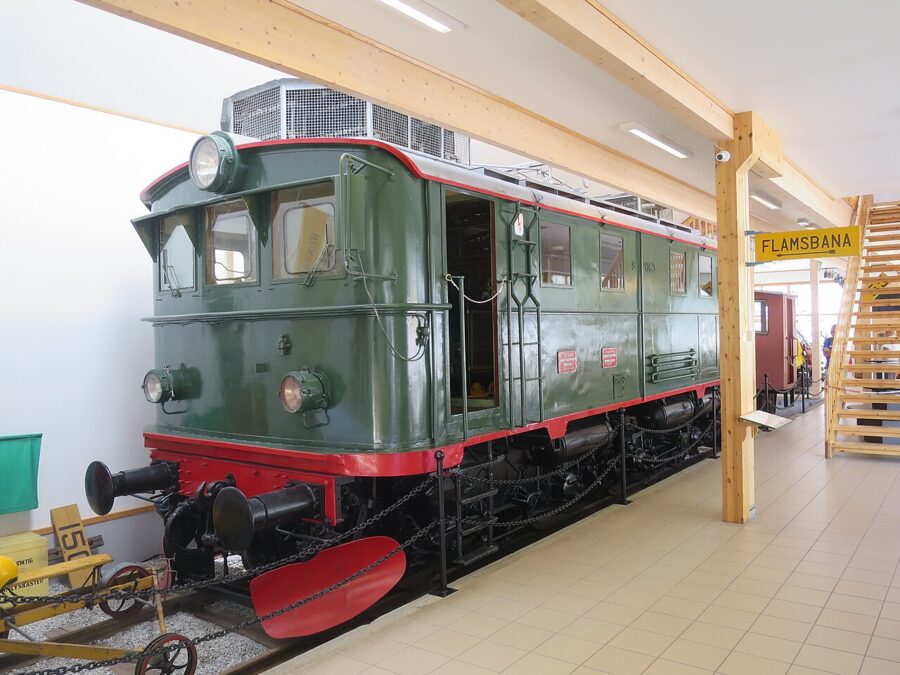
For forty years the question in the newspapers was whether to close it. A year-round road between Oslo and Bergen opened in 1992 and took away the line’s job as Flåm’s lifeline. What saved it was tourism: from 1998 a company set up by Aurland municipality and the state railway took over sales and marketing, and the line got new locomotives, carriages rebuilt in green with wooden interiors, and ten trains a day in summer.
Passengers went from about 350,000 in 1998 to a record 990,000 in 2017, and 956,000 in 2024. That success has a consequence now. The Norwegian Railway Directorate decided in December 2025 not to buy a publicly contracted service once Vy’s agreement ends in December 2027, so from then on the line will be run commercially, by whichever operator wins the train paths. The trains and fares described here are good until then; after that, expect changes and check the timetable again.

Walking or cycling down the valley
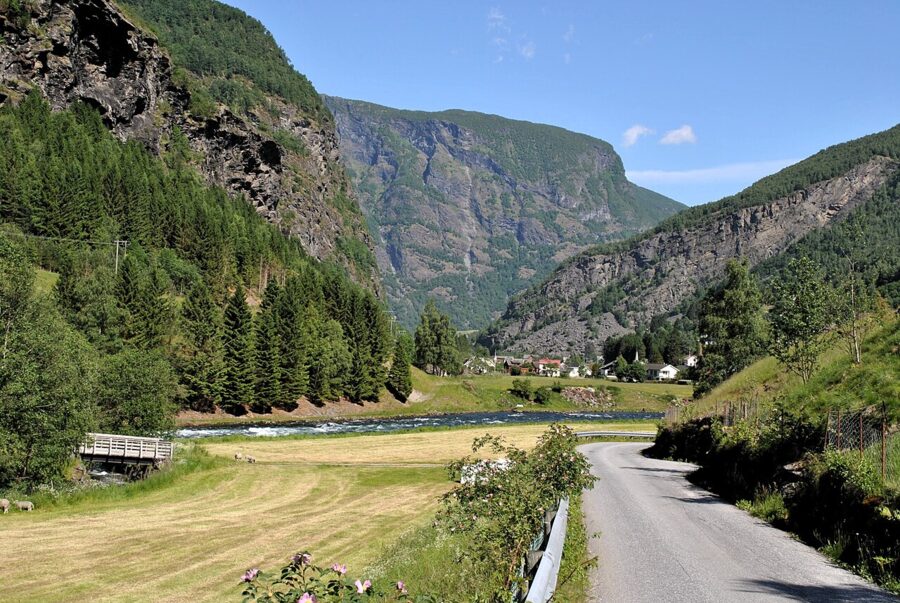
The train is the famous way through Flåmsdalen. The better way, if you have a day and the weather, is to ride up and come down on foot or by bike. The road from Myrdal to Flåm is the last stretch of Rallarvegen, the navvies’ road built to supply the Bergen Line construction in the 1890s and 1900s, and it follows the valley the railway climbs, often within sight of the track.
It is 20 km from Myrdal or Vatnahalsen to Flåm and almost all downhill, 860 metres of descent. Walking takes four to six hours; cycling takes two to three with stops. The top half is gravel, the bottom half paved, and the lower road carries farm traffic, so slow down before blind bends.

The road is normally clear of snow from June to October. In May there can still be snow on the upper section between Myrdal and the junction with the road from Vatnahalsen, and cyclists should walk their bikes there if it is icy. The whole of Rallarvegen from Haugastøl over the Hardangervidda plateau to Flåm is about 80 km and usually passable only from early or mid-July to the end of September; the Rallarvegen snow report is the place to check.
The three ways to do it
- Walk the whole valley. Take the train to Myrdal or Vatnahalsen and walk the 20 km down. Norway’s Best sells the one-way train ticket for this as the Flåm valley hike, from NOK 538. If your knees dislike long descents, this is the version to skip.
- Walk the top, cycle the rest. Walk the 3.5 km of hairpins from Myrdal or Vatnahalsen to Kårdal, collect a bike there and ride the last 17 km to Flåm. Norway’s Best’s train, hike and bike package costs from NOK 913, runs from late April to mid-October, and the bikes must be back in Flåm by 21:00. It is the version I would choose.
- Cycle the whole way. Bring your own bike up on the train (book the space, NOK 280) or rent one in Flåm or at Kårdal. The hairpins are rough and steep at first; walk the bike if in doubt.
On the way down you pass Kjosfossen from below, on a bridge, then the hairpins, Kårdalsfossen and Rjoandefossen, and finally Brekkefossen above the village. At Kårdal, where the zipline lands, a small kiosk sells drinks and snacks in the zipline season. Carry food and water anyway, and clothes for rain at the top.


The Flåm Zipline
From Vatnahalsen a zipline runs 1,381 metres down to Kårdal, dropping 305 metres at up to 100 km/h, the longest in Scandinavia. The Flåm Zipline opens from late April to mid-October, 09:30–17:00, and cyclists coming down Rallarvegen can send their bikes down on a separate lift free of charge. A ticket is valid for an hour and a half, so book a zipline time that fits the train’s arrival at Vatnahalsen.
Norway’s Best sells the train up, the zipline and a bike for the ride down as one package, from NOK 1,649. Without a bike, you can walk the 16 km back to Flåm or 2.5 km to Blomheller for the next train. It is not suitable for small children.
Getting off at a halt
You do not need a package to break the journey. Any one-way ticket to an intermediate halt works: ride up to Vatnahalsen for waffles at the hotel and walk down to Kårdal, or get off at Blomheller and walk the rest of the valley road to Flåm. Tell the conductor where you are getting off, and if you are catching a train back from a request stop, stand on the platform in good time and let the driver see you.

Flåm and onward
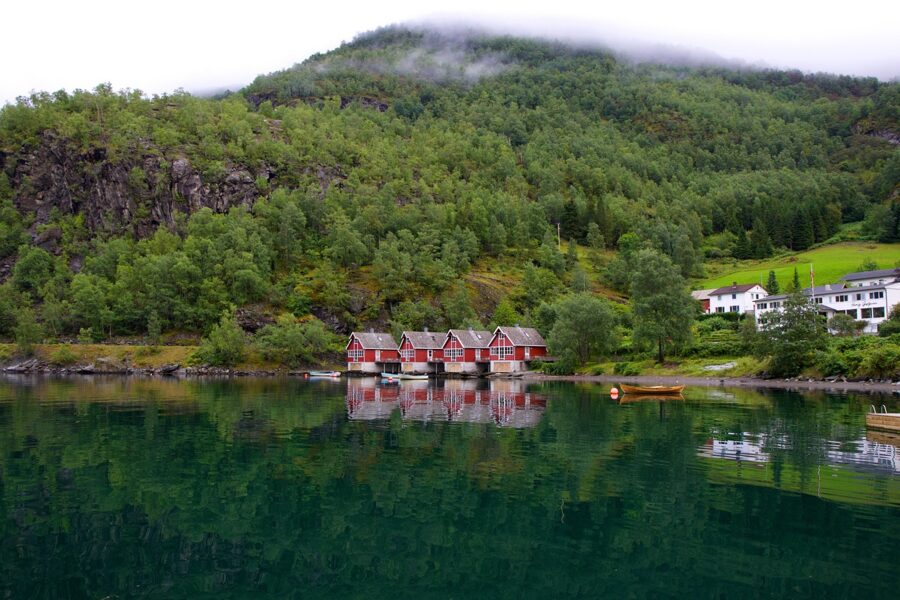
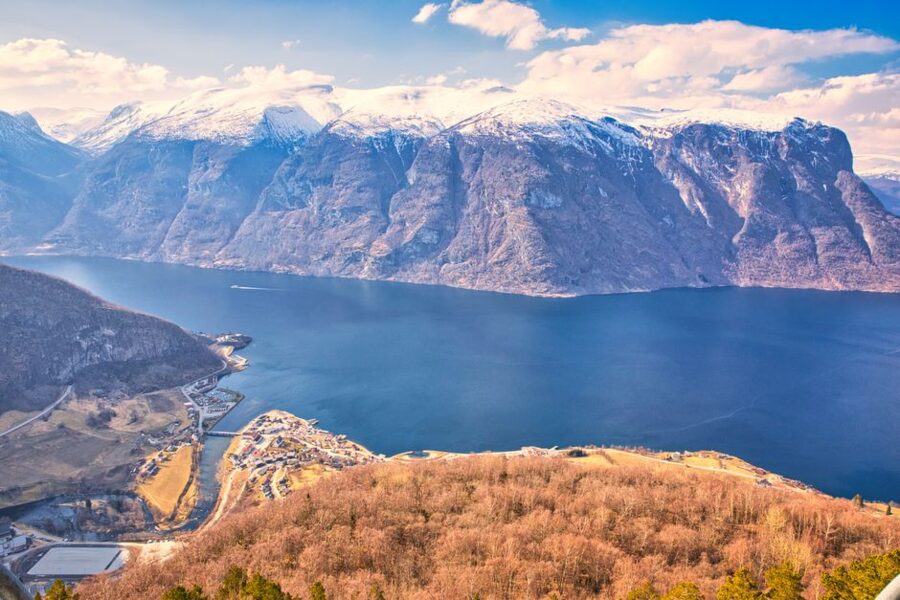
Flåm is a village of about 350 people at the head of the Aurlandsfjord, and in summer most of what happens in it happens within 250 metres of the station. Bags go in the self-service lockers next to the customer centre, at NOK 150–200 a day by size for up to three days; the luggage lockers take cards and are open around the clock. The Flåm Railway Museum is in the old station building next door.
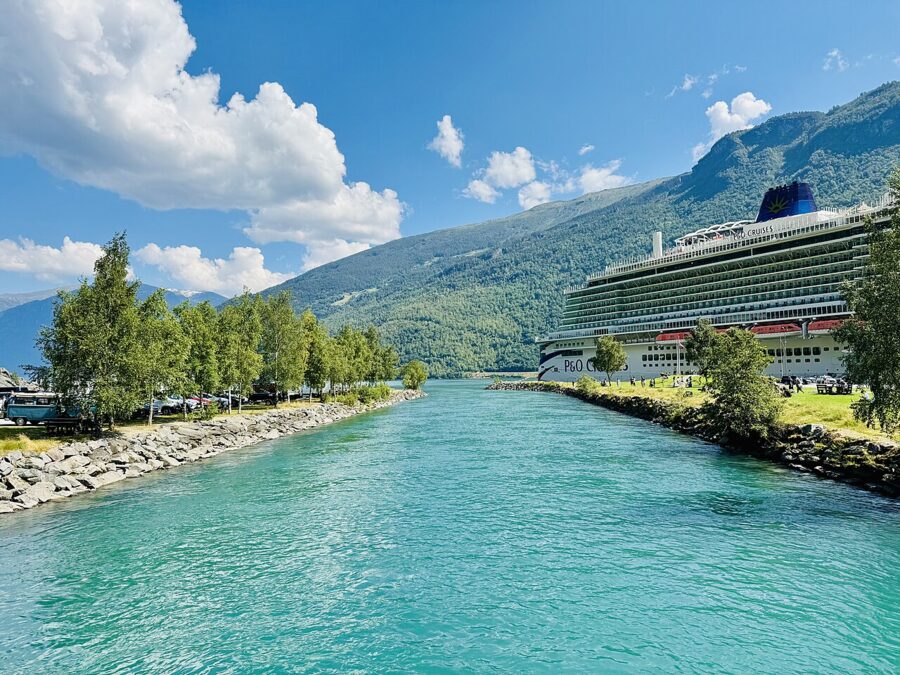


Onward, the boats are the point. The electric sightseeing boat through the Nærøyfjord to Gudvangen leaves from the quay by the station, and from April to October Norled’s express boat runs the length of the Sognefjord to Bergen, which turns the railway into a loop. The Nærøyfjord boat, the bus from Gudvangen to Voss and the Bergen Line home make up the full Norway in a Nutshell loop, and booked leg by leg it can cost less than the package.
If you can spare a night, sleep in Flåm or up at Vatnahalsen and ride the first train of the morning. In summer that means the 07:20 on a weekday, before the ship passengers reach the station. The carriages are cool, the bays are empty, and at Kjosfossen the terrace belongs to the people who got up for it.