
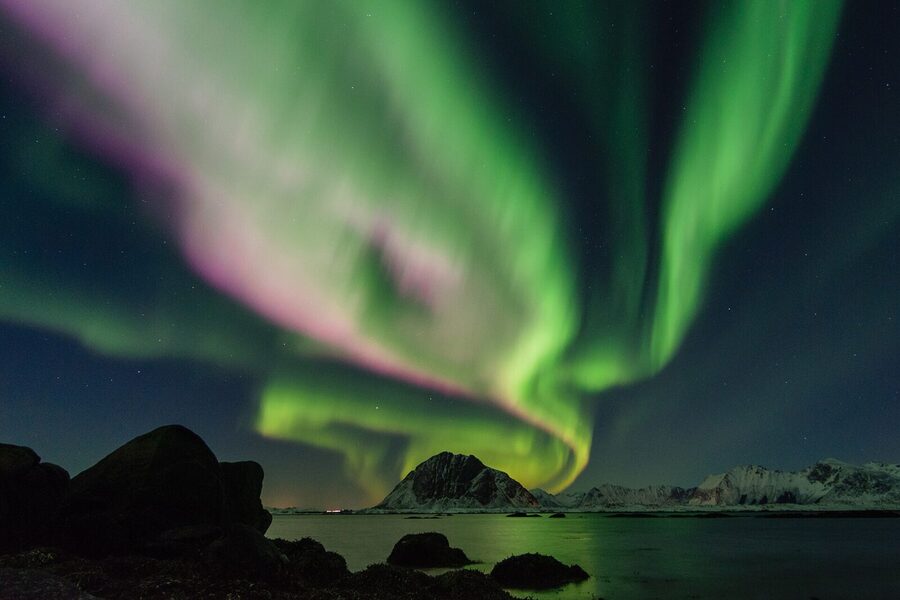

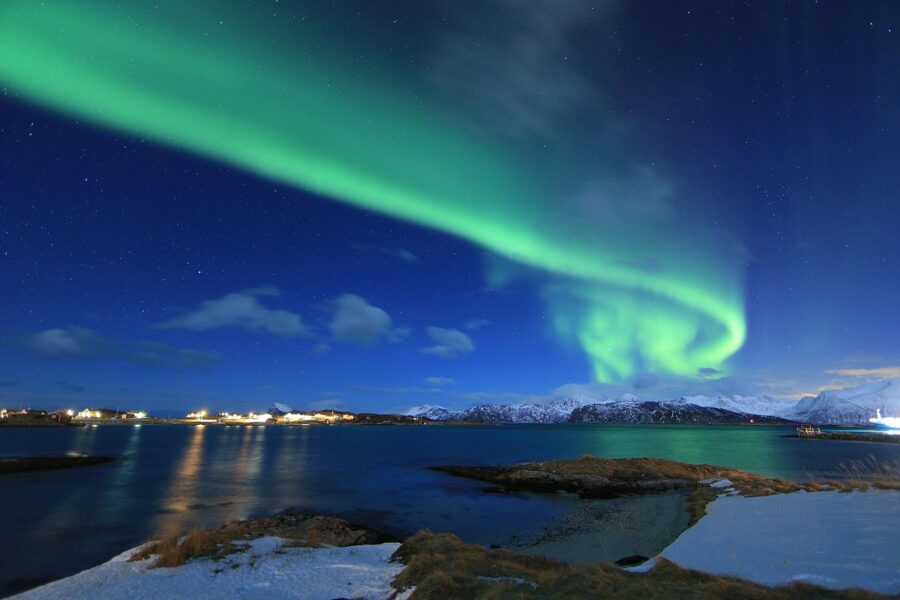
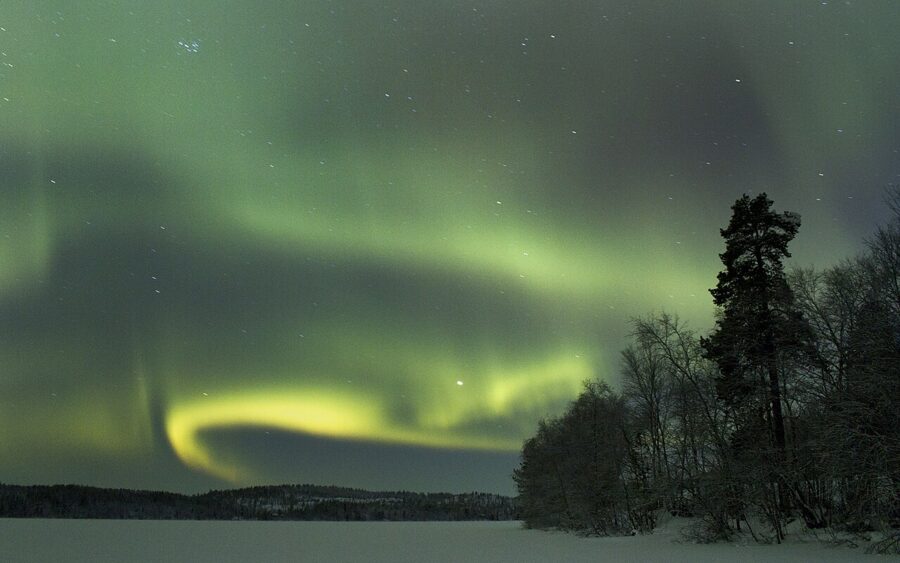
Prestvannet is a small lake on the top of Tromsøya, about twenty minutes uphill on foot from the harbour. On a clear night between September and March you can stand on its frozen edge with the city glowing below you and watch a green band lift out of the north, thicken, and start to move. Nobody sells a ticket for it. The only thing you need from anyone is a cloud forecast.
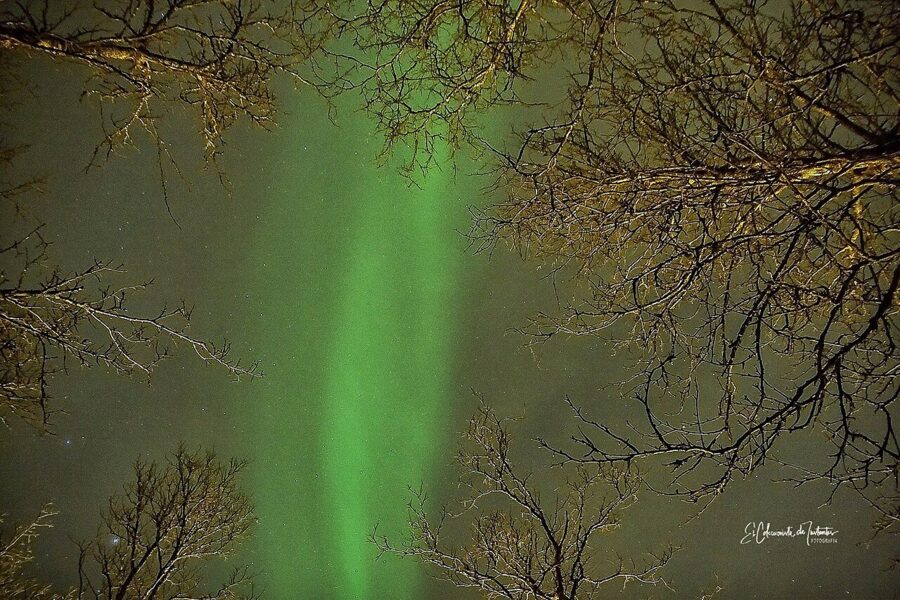
The aurora forms in a ring around the magnetic pole, and at night that ring lies over the coast of Troms and Finnmark and across the border into Swedish Lapland. Under it, from Lofoten to the Varanger peninsula and over to Abisko and Kiruna, the lights show on a large share of dark nights. What stops you seeing them is daylight, cloud and, on a few nights, a quiet sun.
The season runs from late August to early or mid-April, and in practice from September to March, when the nights are long and the tours run. Clear sky decides more than anything else, which is why the choice between the wet outer coast and the drier valleys inland matters more than the choice between towns. Give it three or four nights in one place rather than one night in each of several.
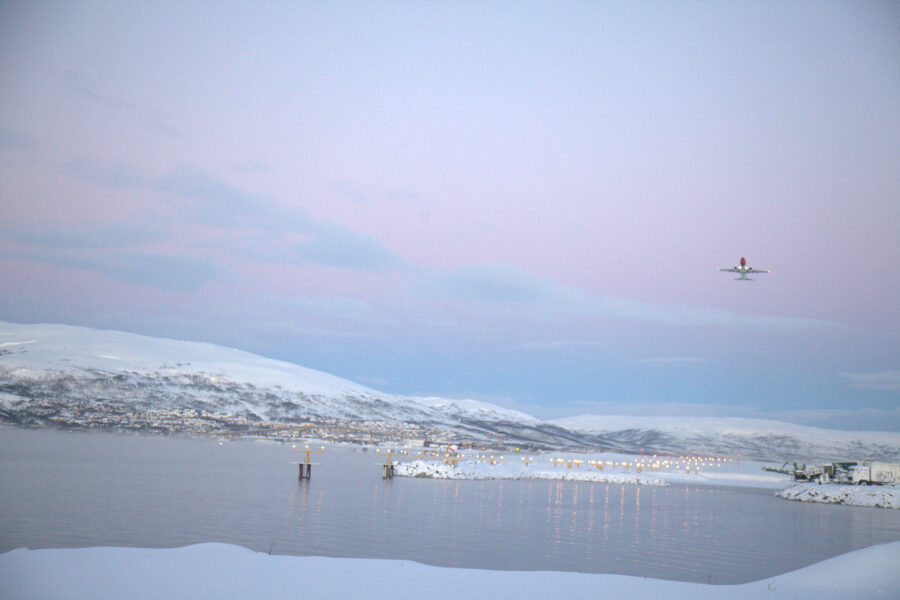
Getting there is simpler than the latitude suggests. More than ten flights a day connect Oslo and Tromsø, taking about 1 hour 50 minutes, and Alta has direct flights to Oslo and Tromsø. For the Swedish side, SJ runs a daily night train from Stockholm Central that arrives in Narvik the next day, stopping at Kiruna, Abisko, Björkliden and Riksgränsen on the way. A guided chase out of Tromsø costs from NOK 1,200 on a big bus to NOK 1,759 in a minibus; standing at Prestvannet costs nothing.
When to go: the season month by month
The aurora does not have a season. It is there in June too; the sky is simply too bright to see it, and Tromsø has midnight sun from 20 May to 22 July. What has a season is darkness, and in the north that returns in the second half of August, first for an hour or two around midnight and then for longer each week.
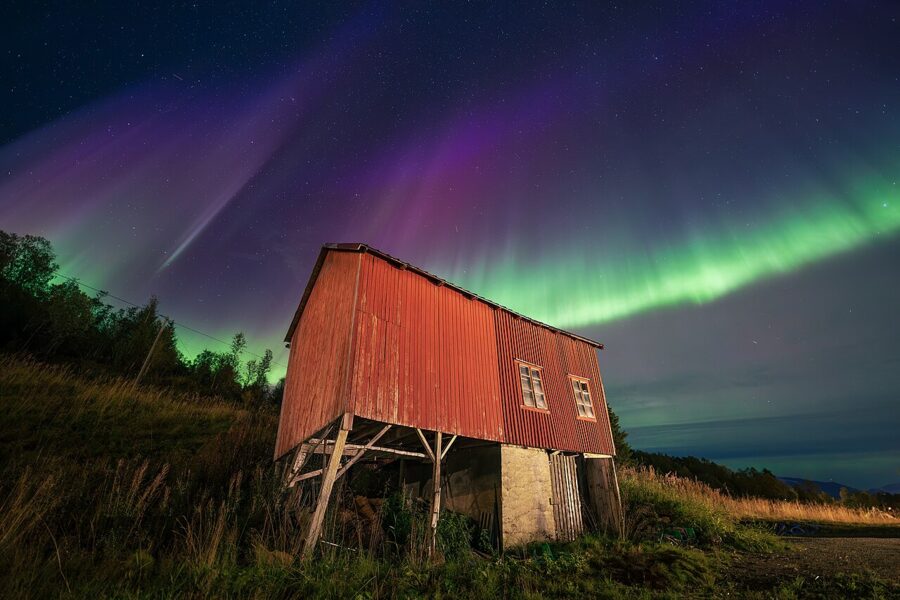
Late August to September. The first dark nights, autumn colour on the birch and no snow below the peaks. Tromsø’s tour operators start in early September; Polar Adventures runs its minibus chase from 1 September and its big bus from 10 September. Nights are short at the start of the month, so the window is late, roughly 22:00 to 02:00.
October and November. The nights lengthen fast and the first snow usually arrives. This is also the stormiest, wettest stretch on the outer coast, so it is the time to base yourself where you can drive inland. Lights Over Lapland in Abisko runs an autumn version of its chase in October and November.
December and January. The polar night: in Tromsø the sun stays below the horizon from late November into January, and Alta has about two months of it. In Lofoten it is shorter, from early December to early January.
You get the most hours of darkness, a few hours of blue and pink twilight at midday, and often the most unsettled weather of the winter. Christmas and New Year fill the hotels.
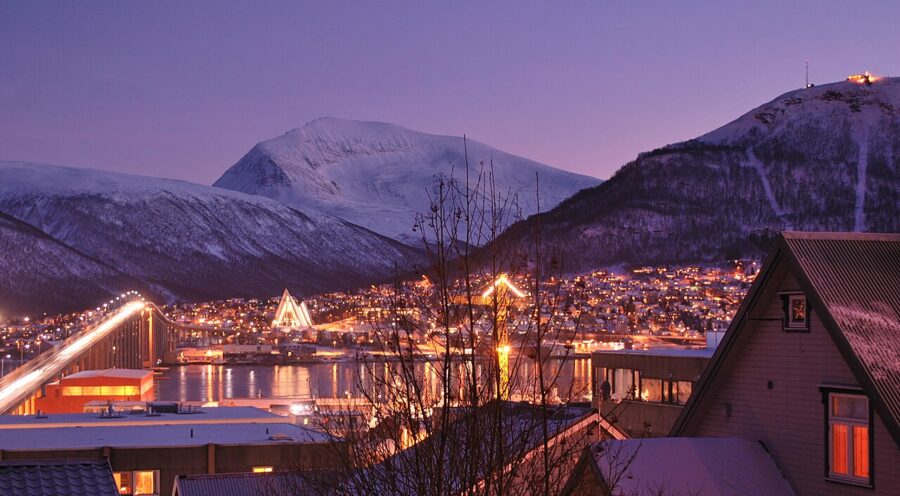
February and March. Colder, with deep snow and, inland, more settled high pressure. The days come back quickly, so you get daylight for dog sledding or the drive and still a long night. March is my pick for a first trip: equinox activity, proper winter on the ground, and the Sorrisniva Igloo Hotel in Alta still open until 31 March.
April. The last of it. Tromsø’s tours stop around 10 April, and by mid-April Lofoten is losing the dark.
Why the equinox months do well
The months around the equinoxes in late September and late March bring more geomagnetic storms than midwinter, because of the angle at which the solar wind meets the Earth’s magnetic field at that time of year. NOAA’s Space Weather Prediction Center notes the tendency in its tips on viewing the aurora, along with the catch: the nights are shortening fast in March and lengthening fast in September. In practice, mid-September to early October and late February to late March give you both good activity and enough darkness.
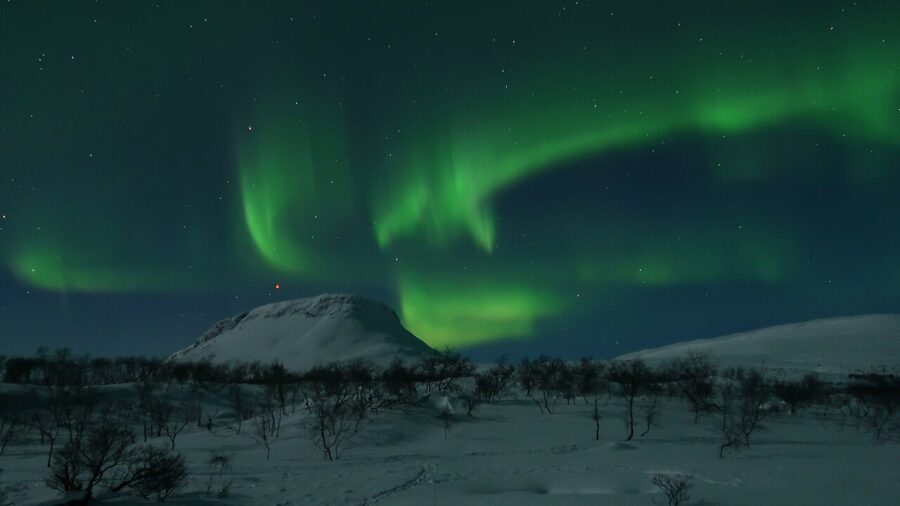
The solar cycle matters less than the headlines suggest. NASA and NOAA announced in October 2024 that the sun had reached its maximum period; the cycle is now declining, though strong storms keep coming for years afterwards. Tromsø’s tourist board puts it plainly: research shows high solar activity makes little difference directly under the oval.
Coast or inland: why the cloud differs
The Norwegian coast is warmed by the Atlantic, which keeps it far milder than the interior, and that same mild, wet air brings cloud. The mountains catch it. Behind them, in the valleys running towards Sweden and Finland, the air is drier and colder and the sky clears more often.
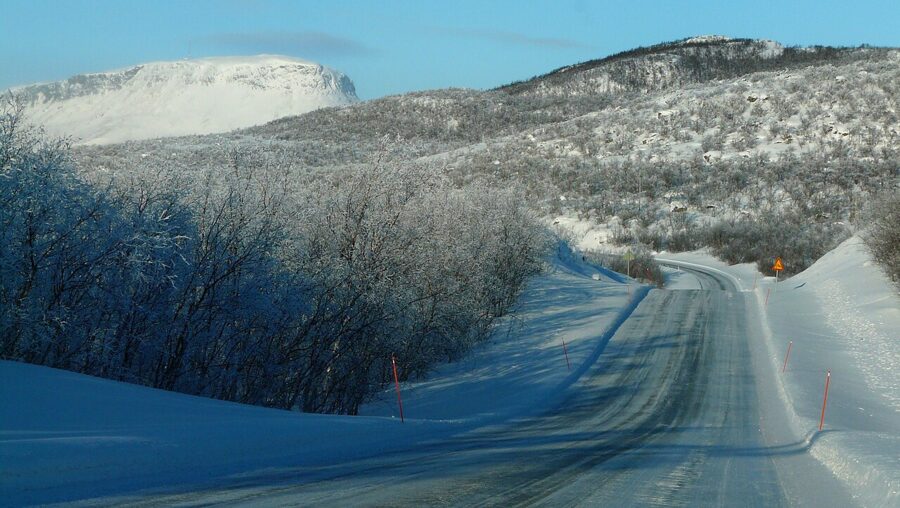
This is why I’d choose a base by its escape routes rather than its reputation. Tromsø has the E8 to Skibotn and Kilpisjärvi; Narvik has the E10 up to the Swedish border and Abisko; Alta has the Finnmark plateau to the south. Lofoten has the least room to run, being a chain of islands in the open sea, though its mountains do break the cloud up and a drive to the other side of an island can be enough.
Where to go: the places compared
Every place below sits under the auroral oval, so the lights are equally likely overhead in all of them on a given night. What differs is the weather, how you get there and how many other people are standing in the same lay-by.
| Place | Getting there | When it’s cloudy | Crowds |
|---|---|---|---|
| Tromsø | Direct flights; airport a short drive from the centre | Chase buses drive inland, as far as Finland | Busy, especially December to February |
| Lyngen | Car, with the Breivikeidet ferry as the short cut | Drier valleys towards Skibotn and the E8 | Quiet |
| Senja | Bridge from Finnsnes; ferry from Brensholmen | Mainland valleys behind Finnsnes | Quiet |
| Lofoten and Vesterålen | Flights to Leknes, Svolvær or Evenes; E10 | Limited; switch sides of the islands | Moderate |
| Narvik | Evenes airport; night train from Sweden | E10 east to the border and Abisko | Quiet |
| Alta | Direct flights from Oslo and Tromsø | Finnmark plateau inland | Moderate |
| North Cape and Varanger | Coastal ships; flights to Kirkenes | Few options; long distances | Very quiet |
| Abisko and Kiruna | Night train; flights to Kiruna | Often clear already; Lights Over Lapland drives on | Moderate in Abisko, busy at the Sky Station |
Tromsø
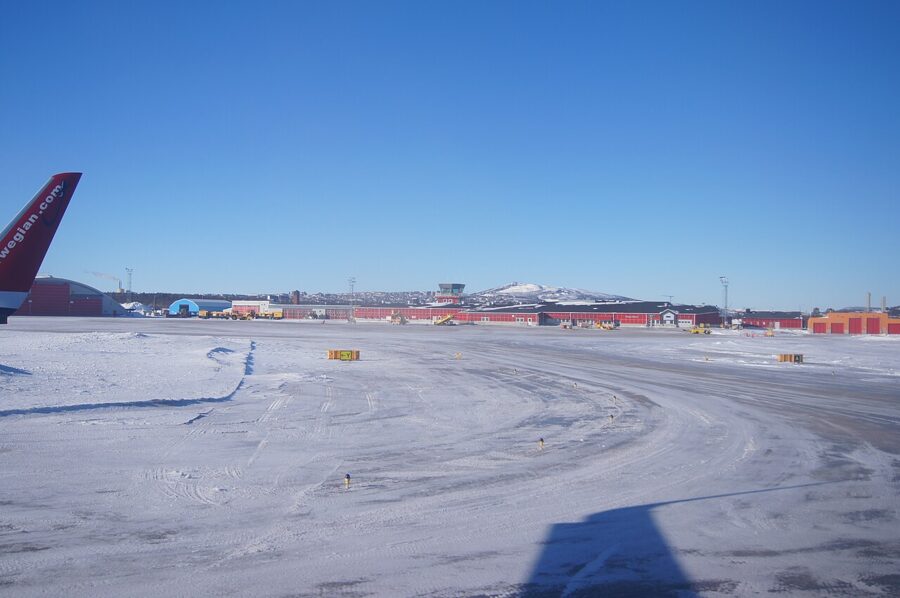
Tromsø is the easy choice and, for a first trip, usually the right one. It has the flights, the hotels and dozens of operators who share information about where the clear sky is on any given night. On a poor night the guides will drive two or three hours inland, sometimes over the border into Finland, to find a gap.
You don’t need a tour on every night. On clear evenings the lights can be seen from the city itself, even from a hotel window, and two darker spots are reachable by local bus or on foot: Prestvannet on the island’s high ground, and Telegrafbukta, the beach on the southern tip of Tromsøya, which is darker still. Visit Tromsø’s page on when and where to see the lights puts the most active hours at about 20:00 to 02:00.
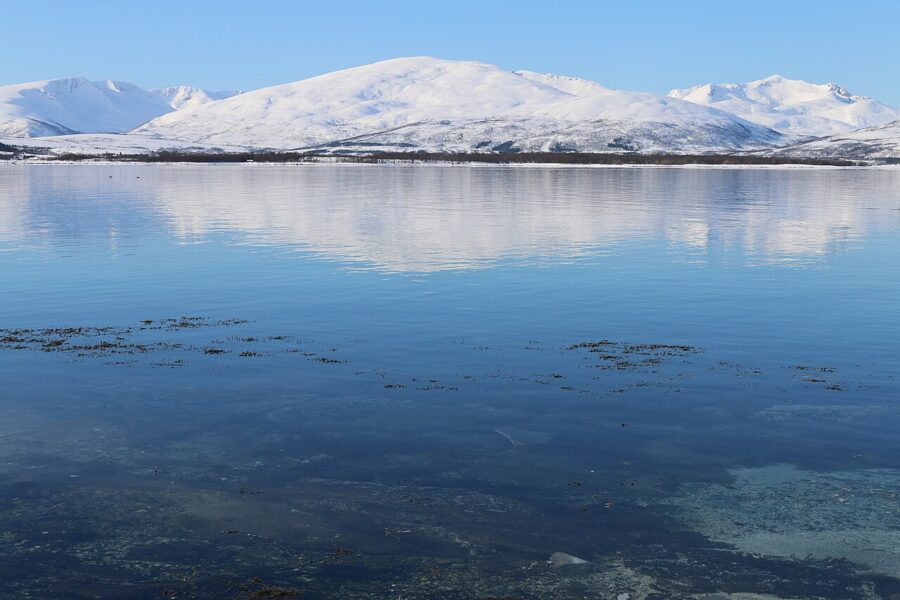
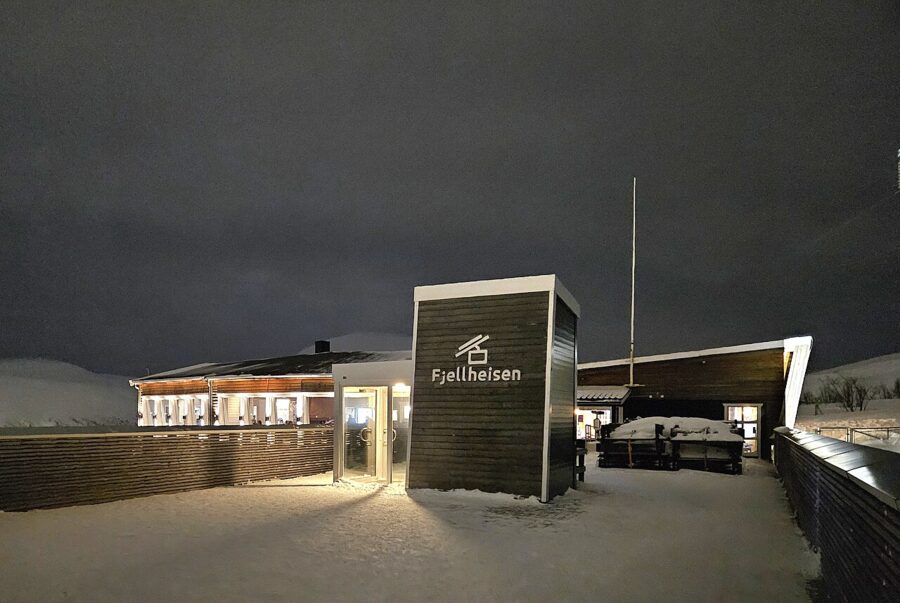
The other way up is Fjellheisen, the cable car from Tromsdalen to Storsteinen, 421 metres up, which takes four minutes and runs on the hour and half hour until midnight. From 30 November the ticket includes a shuttle bus from Scandic Ishavshotel in the centre, but the last one back leaves the lower station at 22:15, so after that you walk or arrange a taxi. There is no parking at the lower station while it is being rebuilt; free parking is about five minutes’ walk away.
The catch with Tromsø is the crowd. From December to February the chase buses often end up at the same dark car parks, and rooms are expensive. If you want Tromsø’s flights without the crush, come in September or October, or stay in town for one night and move out to Lyngen, Kvaløya or Senja for the rest.
Lyngen
The Lyngen Alps rise straight out of the fjord east of Tromsø, and the peninsula they stand on is quiet, dark and close. From Tromsø you drive to Breivikeidet and cross the Ullsfjord on the ferry to Svensby; the second ferry, Lyngseidet to Olderdalen, takes you across the Lyngenfjord. The Lyngen and Ullsfjord ferry timetables show the last crossing, so check it before you set out for the evening.
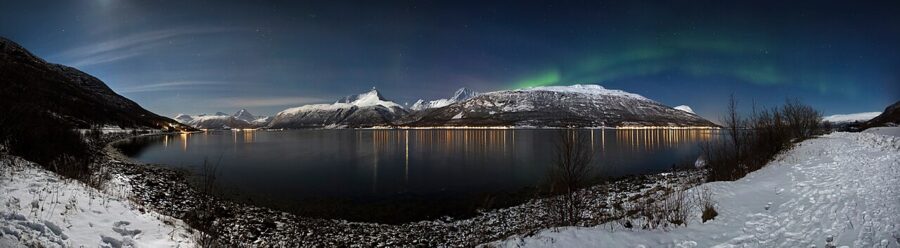
Lyngen’s advantage is that you can see the lights from where you sleep, which is why the region’s guides recommend staying put and adding nights. On a cloudy evening the move is south and east, along the E6 to Skibotn at the head of Storfjorden, where the valley runs up to the Finnish border and is often drier. Lyngen also has some of the Arctic’s glass igloos, which have their own guide.
Senja
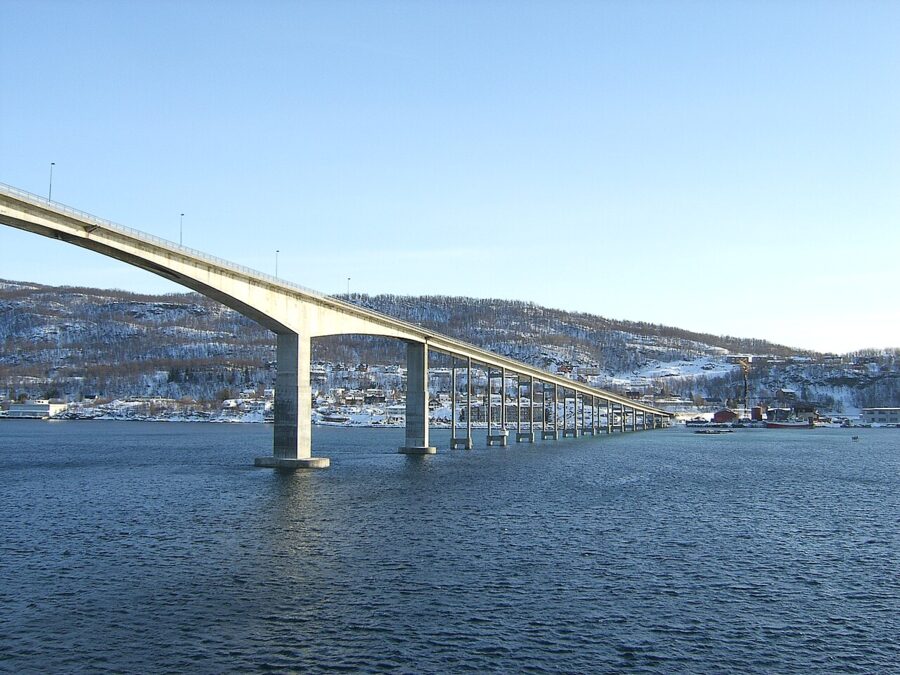
Senja is Norway’s second-largest island and gets a fraction of Lofoten’s visitors. You reach it by the Gisund Bridge from Finnsnes, about two and a half hours by road from Tromsø, or by the ferry from Brensholmen on Kvaløya to Botnhamn on Senja’s northern tip. The National Tourist Route along the outer coast, the Fv862 and Fv86 from Botnhamn to Gryllefjord, passes the fishing villages and the peaks of Okshornan; the Senja tourist route lists the ferry links, including the Gryllefjord to Andenes crossing, which runs only in summer.
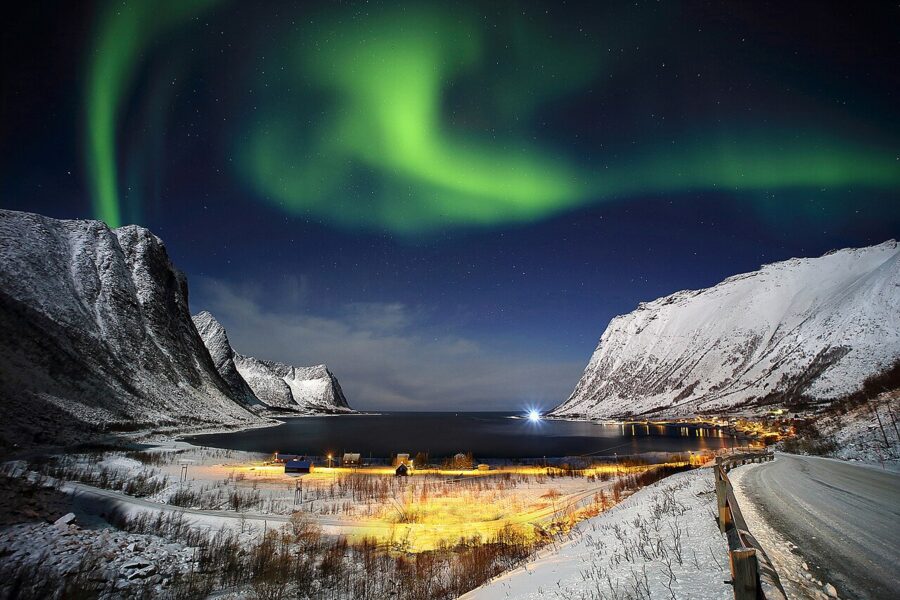
For the aurora, the outer side is the prize: north-facing fjords, no towns to speak of and very little traffic after dark. The weakness is the same as Lofoten’s. When the Atlantic weather sits on the outer coast, your best option is to drive back over the bridge and inland towards Bardu and Målselv, which costs an hour or more each way.
Lofoten and Vesterålen
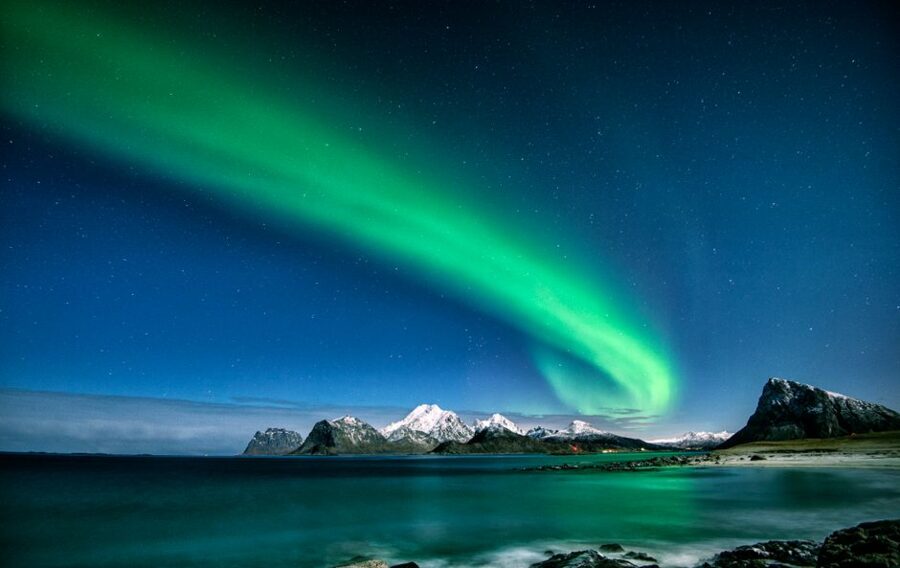
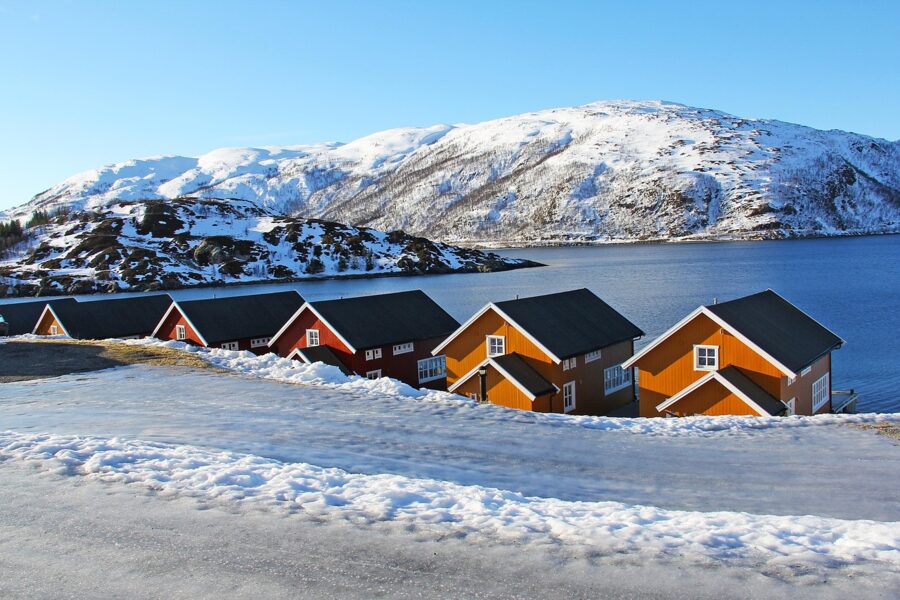
Lofoten gives you the photograph everyone has seen: the aurora over a red cabin, a white peak and a dark bay. It is one of the best places in Norway to look at the lights and one of the hardest in which to chase them, because there is so little room to run from the weather. The season runs from late August to mid-April.
Fly to Leknes or Svolvær, or to Evenes for Vesterålen and the eastern end of the chain, and rent a car; the E10 runs the length of the islands. Guided options are fewer than in Tromsø and more expensive. Arctic Guide Service’s private northern lights chase costs NOK 9,500 for a group of one to seven, with pick-up included on Vestvågøy.
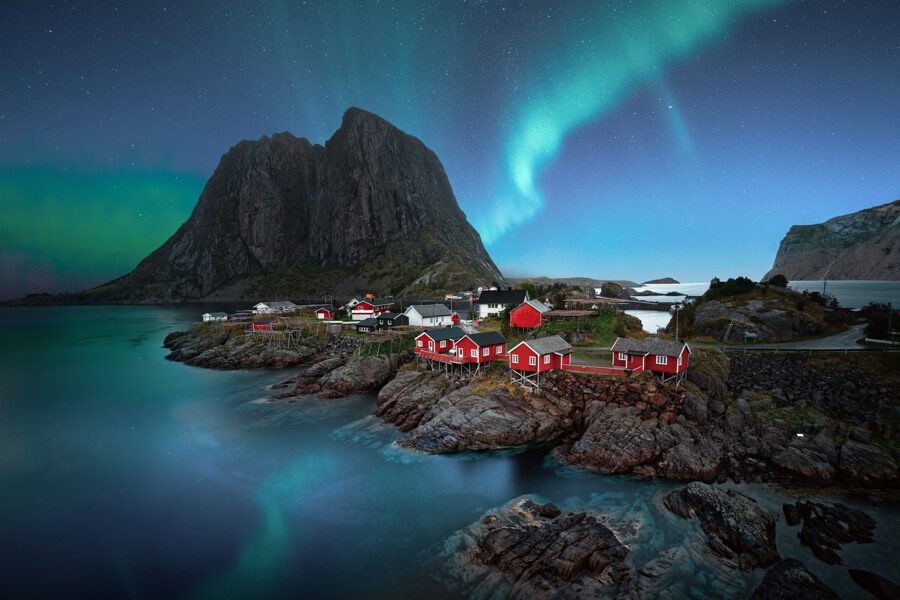
Vesterålen, to the north, is the quieter half. The islands are lower and broader, the light pollution is minimal and the roads are emptier. If you’re there for dinner as well as the sky, the farm restaurant Kvitnes Gård makes a long evening worth the drive.
Narvik
Narvik is the overlooked one. It sits at 68 degrees north on the Ofotfjord, with Evenes airport an hour away, the night train arriving from Sweden and the E10 climbing straight up to the border and Abisko. The town’s tourist board makes the point I’d make: within a short drive the weather can differ between the fjord, the valleys, the mountain and the inland side, so aurora hunting around Narvik is mostly a matter of choosing which way to go.
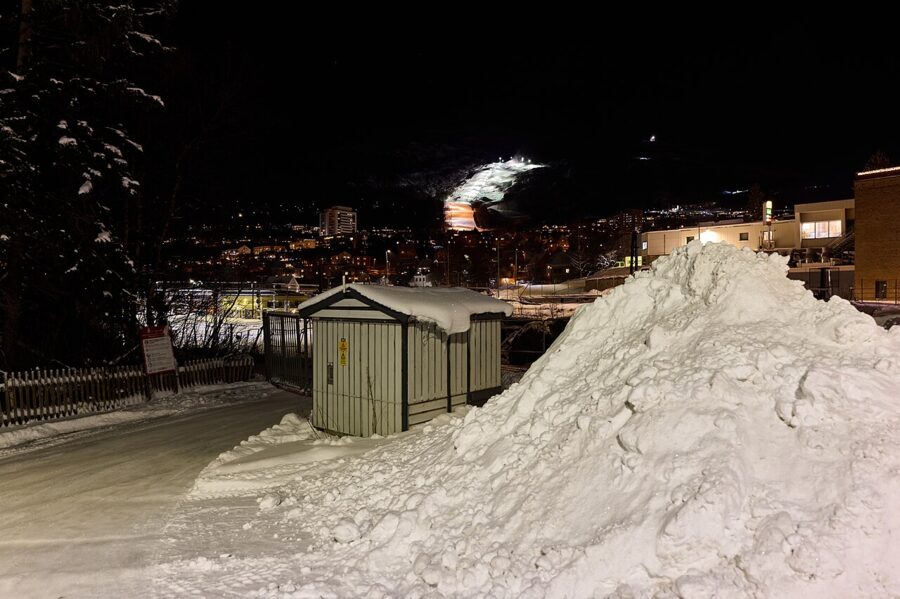
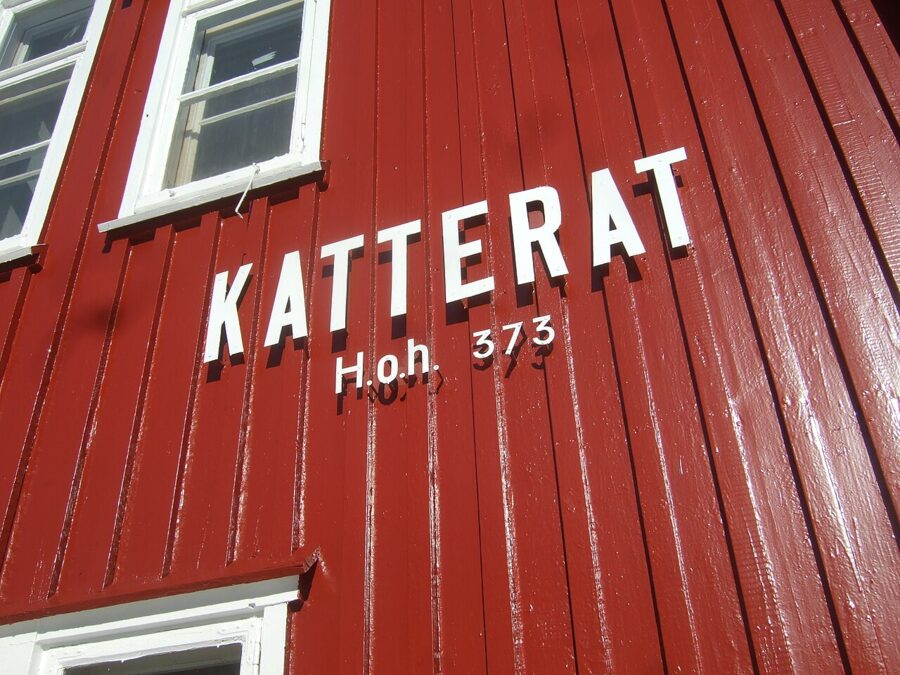
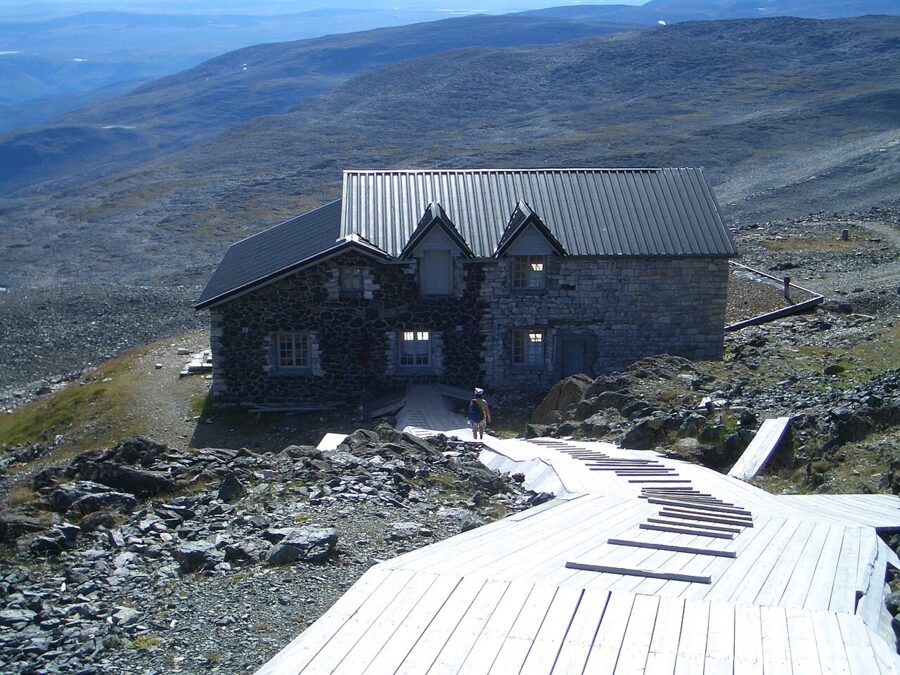
Two things make Narvik worth a night. The northern lights gondola takes you up to the Fjellheisrestauranten, 656 metres above the fjord, with a fire outside, a hot drink and a waffle included, for up to two hours; there is no guiding, and the last gondola down is at 22:00. And in past winters a northern lights train has run from Narvik station up the Ofotbanen to Katterat, a station with no road, where guests wait for the lights by a fire and a lavvo; check Visit Narvik for this season.
Narvik is also where Norway and Sweden join up. Abisko is 80 km east on the E10, an hour to an hour and a half by car depending on the road, or a short ride on the same train, so a week can easily be split between the Norwegian fjord and the Swedish mountains.
Alta
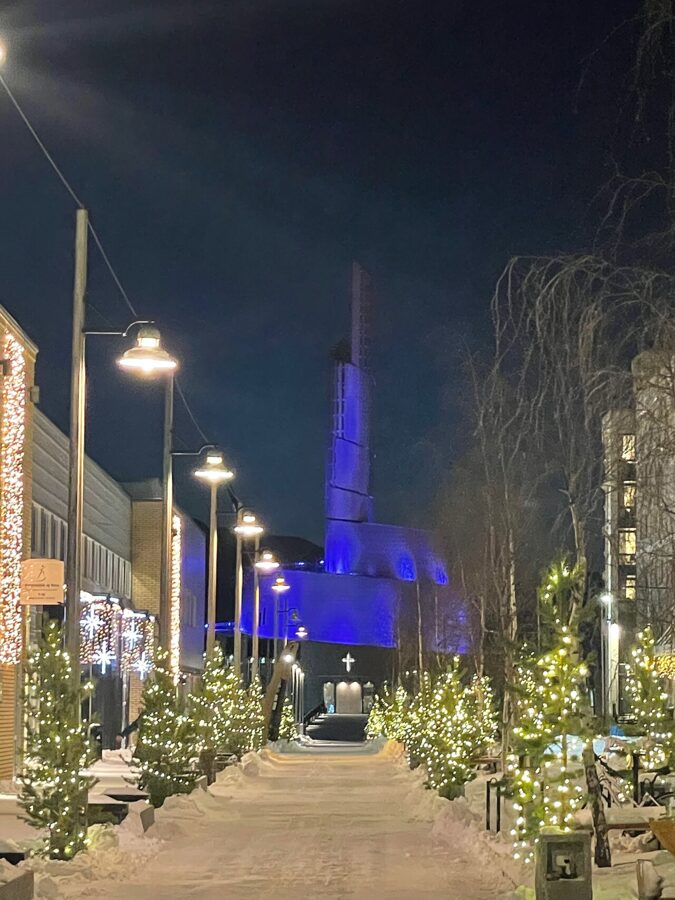
Alta calls itself the city of the northern lights, and it has a claim older than tourism: the world’s first permanent aurora observatory was built on the mountain Haldde above the town. Alta sits at the head of its fjord where the coast meets the Finnmark plateau, with a steadier inland climate and more clear nights than the outer coast.
Experienced hunters in Alta go either out to the Arctic coast or south onto the open plateau, depending on where the cloud is, and the operators listed on Alta’s northern lights page cover both, by car, snowmobile and reindeer sleigh. The Sorrisniva Igloo Hotel, rebuilt from ice and snow every winter beside the Alta river, is open from 20 December to 31 March and charges NOK 395 to look round for the 2026/27 season.
The North Cape and Varanger coast
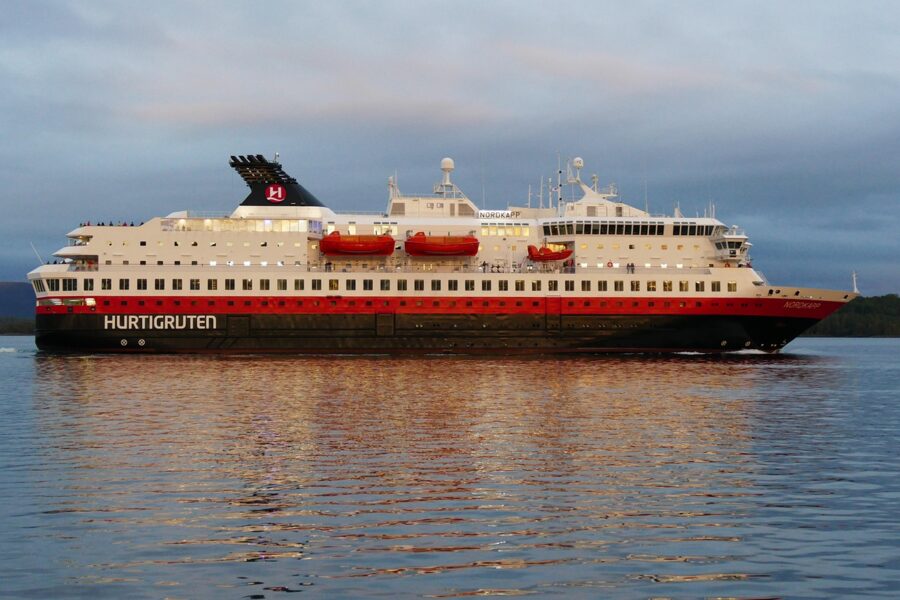
Further east the land flattens into the Barents Sea, and the horizon opens up in a way it never does among the Lofoten peaks. The coastal ships of Hurtigruten and Havila sail it every day, calling at Honningsvåg for the North Cape, Vardø and Kirkenes, and a ship is the least stressful way to see it in winter.
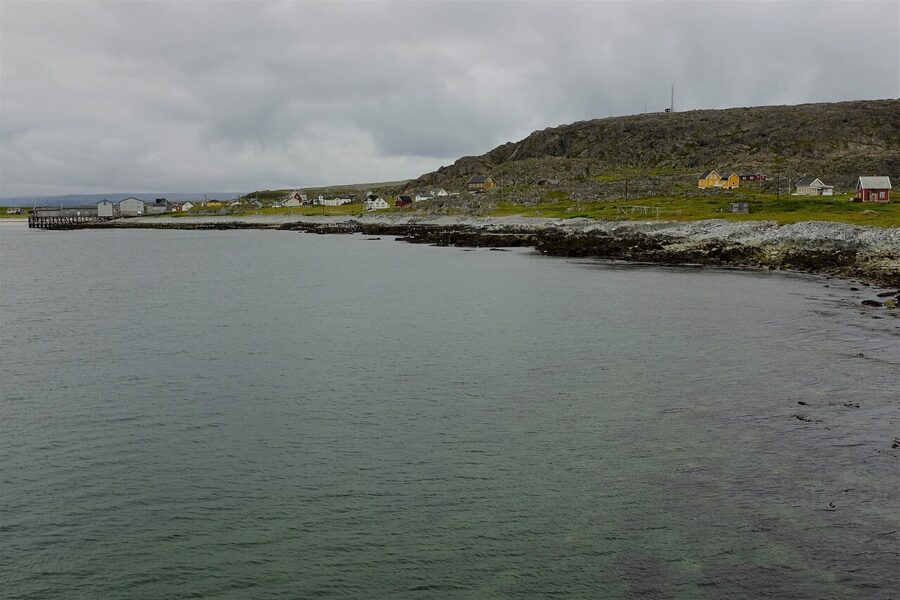
By road, the North Cape is reachable in winter, but the last stretch of the E69 from the Skarsvåg junction runs in convoy at fixed times and closes in storms. On the Varanger peninsula, the Varanger tourist route follows the fjord from Varangerbotn to Vardø and on to Hamningberg, but the section from Smelror to Hamningberg is closed in winter; in recent years it has shut as early as 4 November and reopened as late as 25 May.
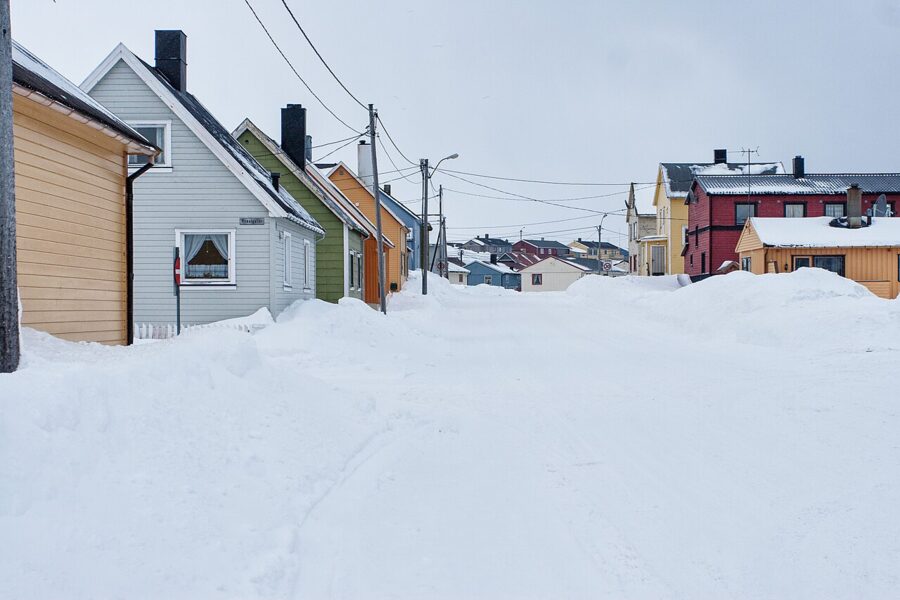
Kirkenes, at the end of the line, has an airport and a long polar night. The aurora here is as frequent as anywhere in Norway, the weather can be harsh, and the distances between places mean that when it clouds over there is usually nowhere close to go.
One step further north is Svalbard, where during the polar night the daytime part of the oval passes overhead and the aurora can appear in the middle of the day.
Abisko and Kiruna, Swedish Lapland
Abisko is a village and a national park on the south shore of Torneträsk, 100 km north-west of Kiruna and 80 km east of Narvik. It is known for the blue hole of Abisko (det blå hålet), a patch of sky over the lake that often stays clear when the mountains around it are under cloud. The Aurora Sky Station says it is open about 90 per cent of its scheduled time and that the lights are visible on about 70 per cent of the evenings it opens.
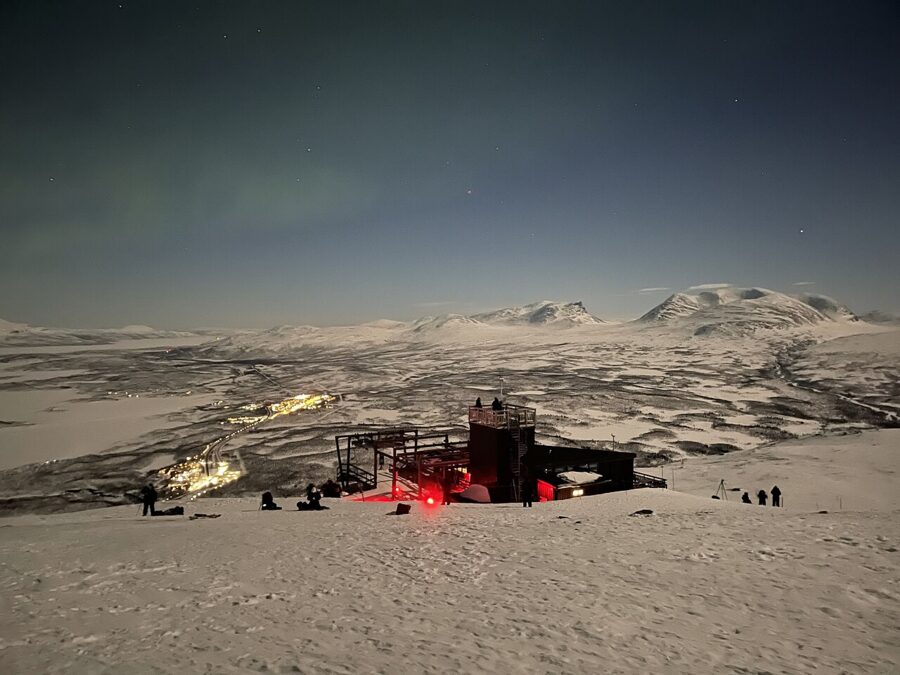
The night visit to the Aurora Sky Station runs from 20:30 until 01:00 at the latest, with a chairlift up Nuolja, a talk, a short walk on the mountain and a café; there are only 40 places, and in hard weather the evening moves to a wood-heated lavvo in the park. STF Abisko Turiststation, the Swedish Tourist Association’s mountain station at the foot of the lift, lists it from SEK 1,295, with the aurora dinner from SEK 2,395, a guided northern lights hike from SEK 950 and a plain chairlift ticket from SEK 260.
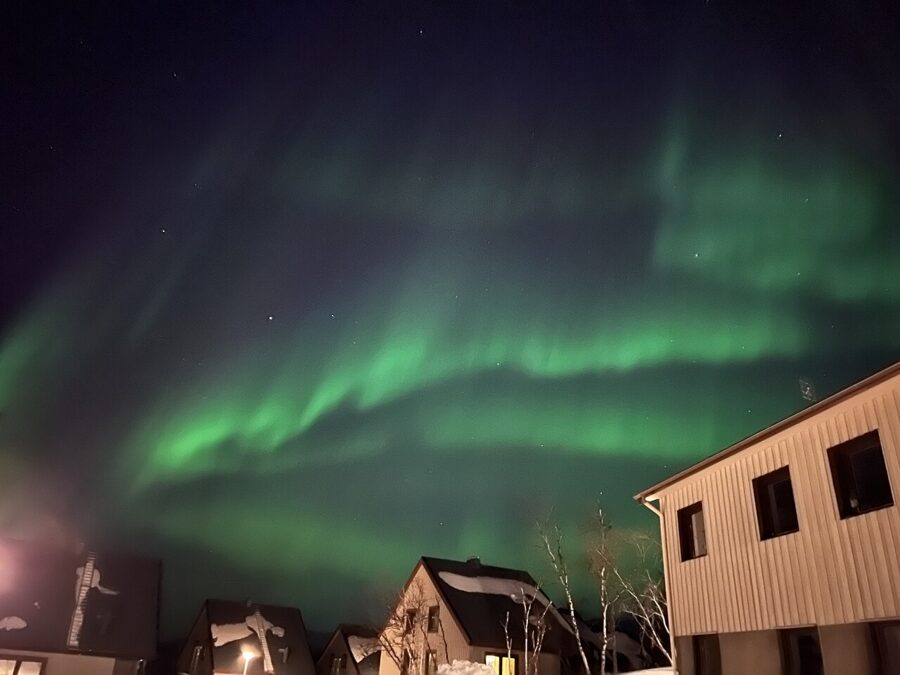
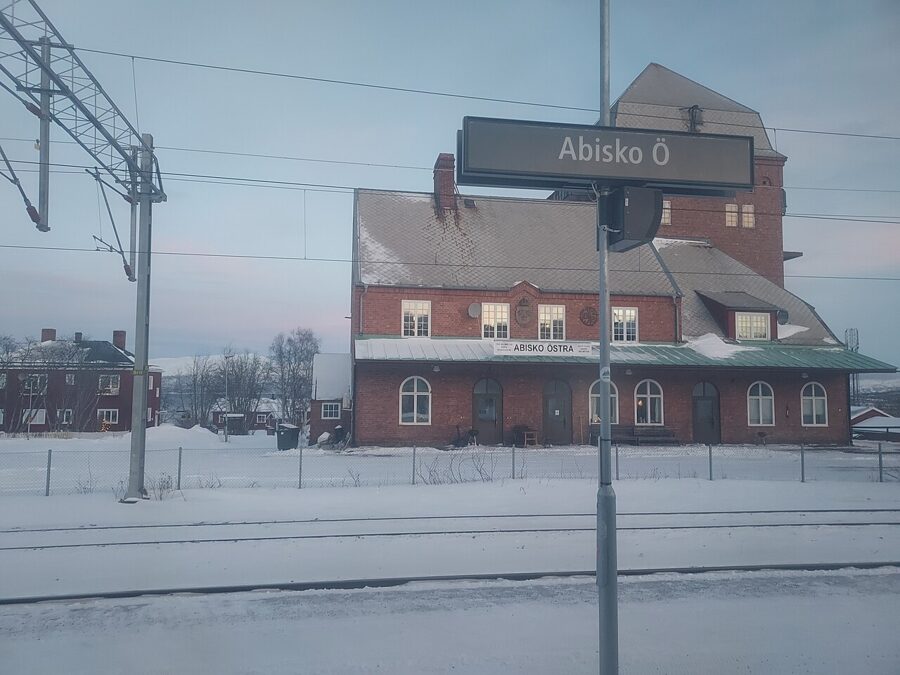
Abisko has two stations on the line: Abisko Östra for the village and Abisko Turiststation for the mountain station, five minutes’ walk from reception. The night train from Stockholm stops at both, and train tickets are usually released about 90 days ahead. From Kiruna airport, about 90 minutes’ flight from Stockholm, the Länstrafiken Norrbotten airport bus, scheduled transfers between December and March, or a hire car cover the 100 km; the drive takes 1.5–2 hours. Lights Over Lapland’s Abisko aurora chase picks up at Abisko hotels from 20:00 between December and March, and doesn’t cancel for cloud, only for unsafe conditions.
Kiruna is the practical base rather than the scenic one: an airport, a mining town with more beds and tours, and a longer drive to the darkest skies. Further up the line, Björkliden and Riksgränsen sit right on the border, and Riksgränsen has Niehku, a lodge and dining room built where the railway’s locomotive shed once stood. The road between Narvik and Abisko can close in extreme weather, and winter tyres are compulsory on the Swedish side.
Reading the forecasts
Check the cloud first, then the aurora. Under the oval the lights are likely on most nights, but a solid layer of low cloud hides everything, and no amount of solar activity gets through it. The aurora shines 100–120 km up; the cloud that matters is a few hundred metres to a few kilometres above you.
For cloud, use the Norwegian Meteorological Institute’s forecasts on Yr, which show cloud cover hour by hour, split into low, medium and high cloud. That split matters. As Yr’s own guide to its aurora forecast says, a high cloud layer is often thin enough to see the aurora through, while low cloud is usually dense and blocks it. On a mixed night, look at the cloud map and the satellite picture and drive towards the gaps.
The aurora forecast, and what Kp does and doesn’t tell you
Yr also carries an aurora forecast up to three days ahead under its “other forecasts” tab, and a short-range nowcast that gives a figure from 0 to 100 per cent for the next 30–90 minutes, the time the solar wind takes to travel from the monitoring satellites to Earth. The Yr app can send a push alert for a place when the nowcast goes over 30 per cent.
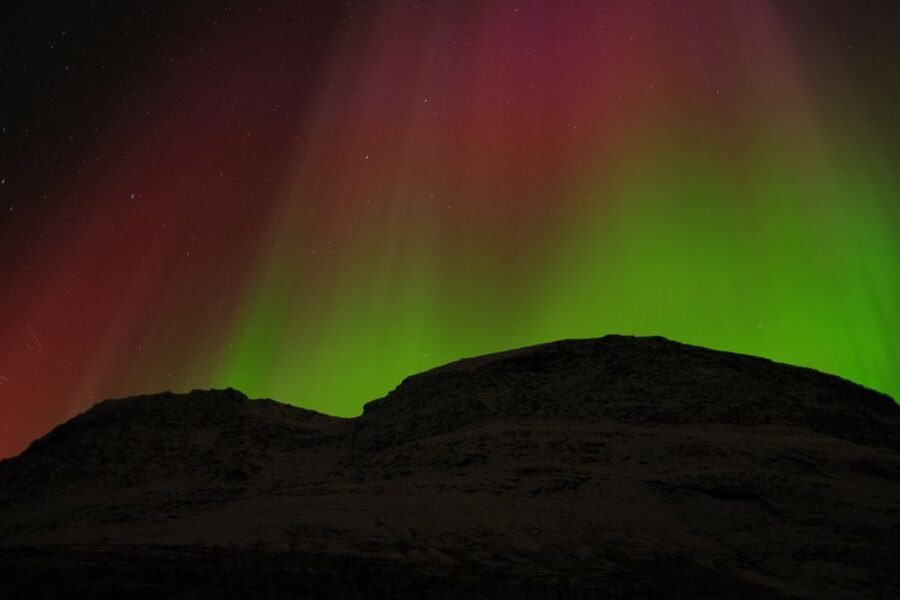
Kp is the number everyone quotes, and it is often misread. It runs from 0 to 9, it is calculated in three-hour blocks, and it measures how disturbed the Earth’s magnetic field is worldwide; NOAA works out its estimated planetary Kp from eight magnetometers, the nearest of them in northern Germany. A high Kp means the oval is expanding south, which matters in Oslo or Trondheim. Under the oval, in Tromsø, Alta or Abisko, a Kp of 2 or 3 on a clear dark night is often enough, and Kp 5 and above counts as a geomagnetic storm.
For a local reading, the Tromsø Geophysical Observatory at the Arctic University of Norway publishes live magnetometer and all-sky camera data from Tromsø itself, and the Aurora Sky Station keeps two cameras running over Abisko with the last 24 hours archived. When the magnetometer trace starts swinging, go outside.
Two more things. The moon washes out faint aurora, so the week around new moon gives the darkest skies, though a strong display still shows in full moonlight, with the snow lit for photographs. And the lights come in bursts: a quiet arc can sit on the northern horizon for an hour and then break up across the whole sky in a few minutes, so don’t go in the moment it looks dull.
A night out: chase, stay put, or drive yourself
There are three ways to spend an aurora night, and the right one depends on the weather more than on your budget. On a clear night anything works. On a mixed night a guide with a phone full of other guides’ reports earns the fare.
Chasing by minibus or bus
A chase means a guide picks you up in the early evening and drives to wherever the forecast and the other guides suggest, sometimes a few kilometres, sometimes 200. In Tromsø, Polar Adventures runs two versions from its office on Killengreens gate. The big-bus chase takes up to 45 people, leaves at 17:45, lasts about seven hours and costs NOK 1,200, with a thermal suit, hot drinks and a toilet on the bus. The minibus chase takes 3–17 people, costs from NOK 1,759 (NOK 1,299 for children), drops you at your hotel, and offers 30 per cent off a new tour if you see nothing.
Book ahead from December to February, when the smaller tours sell out. Check what is included before comparing prices: a thermal suit, food, photographs and a hotel drop-off can make the cheaper tour the more expensive night. Nobody guarantees the aurora, and the operators say so in their terms.
Staying put: a cabin, a camp or a glass roof
The other approach is to choose one dark place and stay there for several nights. A cabin on Kvaløya, Senja or the Lyngen shore, with a view north and no streetlight, gives you the whole night rather than the slot a tour can offer, and the lights often turn up after the buses have gone home. Tromsø’s operators also run fixed camps with lavvos, fires and toilets, which suit families who don’t want seven hours in a vehicle.
The glass huts and domes, where you watch from bed, are covered in the glamping guide. Fjellheisen, the Narvik gondola and the Aurora Sky Station are the other way of staying put, lifting you above the valley lights with somewhere warm to retreat to.
Going alone with a car
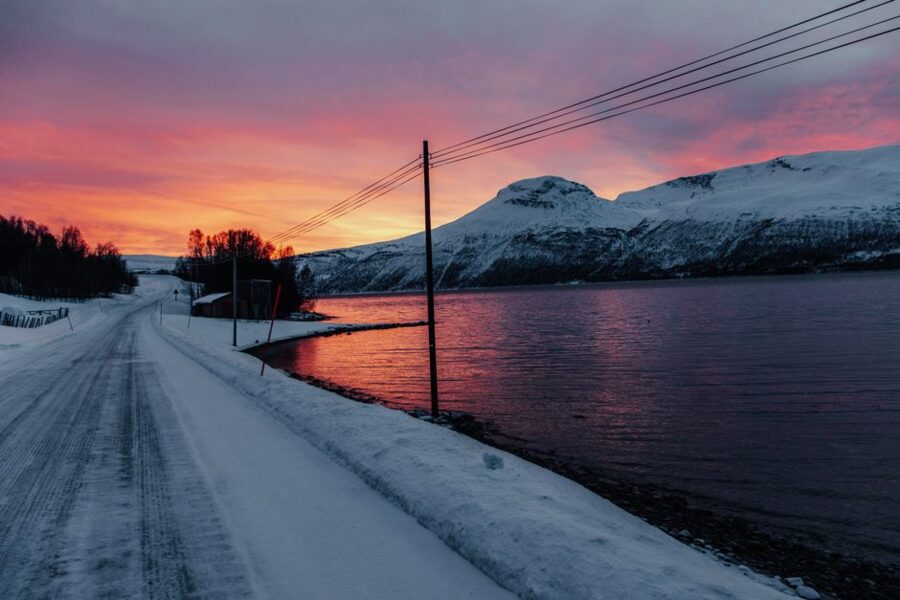
Driving yourself is the cheapest way for two or more people, and the freest. It also means winter driving on dark, icy, narrow roads after a long day, which is where most of the risk in an aurora trip lies. Hire cars come with winter tyres; take studded ones if you have the choice, keep the speed down, and watch for reindeer and elk, which stand in the road and don’t move.
Tromsø’s northern lights guidelines are blunt about what goes wrong. Don’t stop on a bend or in the road, and don’t walk along it in the dark; wear a reflective vest. Rest areas are used by lorry drivers on their legal breaks, so don’t fill them with tripods. Fires need at least 10 metres between them and any vehicle, never in a lay-by, and leave no trace.
Check the road before you leave: Statens vegvesen’s traffic map shows closures and convoy times, and the high roads, such as the E69 to the North Cape and the E10 to Abisko, are the ones most likely to close. The right to roam (allemannsretten) lets you walk on uncultivated land to watch the sky, but not into gardens or onto farmland, and not with a car.
What to wear
You will stand still for hours, which feels far colder than skiing at the same temperature. Dress in layers: wool next to the skin, wool or fleece in the middle, and a windproof outer layer with insulated trousers. Add a warm hat, mittens rather than gloves, roomy boots with space for thick socks, and spikes for icy paths. The Aurora Sky Station adds one tip worth repeating: don’t shower just before going out, and skip water-based face cream, which can encourage frostbite.
What a night costs
| Option | Where | Price | Season |
|---|---|---|---|
| Polar Adventures big-bus chase, up to 45 people, about 7 hours | Tromsø | NOK 1,200 | 10 September–10 April |
| Polar Adventures minibus chase, 3–17 people, about 7 hours | Tromsø | from NOK 1,759 (child NOK 1,299) | 1 September–10 April |
| Arctic Guide Service private minivan chase, 1–7 guests | Lofoten (Vestvågøy) | NOK 9,500 per group | dark season |
| Aurora Sky Station night visit | Abisko | from SEK 1,295 | dark season |
| Aurora Sky Station dinner | Abisko | from SEK 2,395 | dark season |
| STF guided northern lights hike | Abisko | from SEK 950 | dark season |
| Chairlift ticket, Nuolja | Abisko | from SEK 260 | open with the lift |
| Sorrisniva Igloo Hotel entrance | Alta | NOK 395 | 20 December–31 March |
| Walking to Prestvannet or Telegrafbukta | Tromsø | nothing | late August–early April |
Prices change from season to season, so check the operator’s own page when you book.
Photographing it, briefly
Recent phones do this well. Use night mode, rest the phone on something solid or a small tripod, and don’t zoom. Expect the photograph to show more colour than your eyes did: a faint aurora looks grey-green to the eye and bright green on a sensor.
With a camera, use a tripod and manual settings: the widest aperture you have (f/1.8–f/4), ISO 800–3200, and 5–20 seconds’ exposure, shorter when the lights are moving fast. Focus manually on infinity or on a distant light before it gets fully dark. Cold drains batteries quickly, so keep a spare in an inside pocket. Use a red or dimmed headlamp and don’t point it at the people around you, who are trying to do the same thing.
Then look up from the screen. The best minutes of a strong night are when the lights fill the sky overhead, and no lens takes that in.
The road back
The chase buses come back into Tromsø around 01:00, and on a quiet night the E8 out of Skibotn towards Kilpisjärvi is empty from the fjord to the border. If the forecast for your first night shows low cloud over the coast and a clear patch inland, that is the road to be on, with a flask in the door and the cloud map open on the passenger seat. If it shows clear sky over Tromsøya, leave the car where it is and walk up to Prestvannet.